Xin chào (hello) from Vietnam—where our journey begins aboard an Avalon Mekong River Cruise. We were especially excited to sail with Avalon Waterways because of their unique approach to river cruising and their reputation for exceptional service.
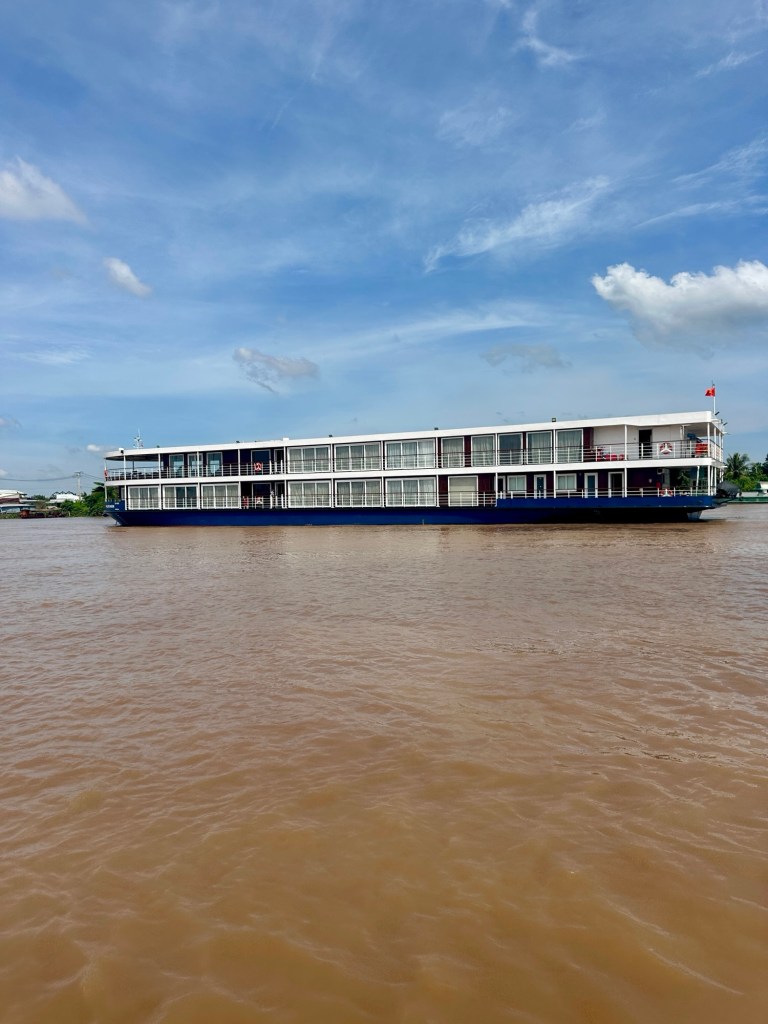
Unlike traditional European river cruises, Avalon’s Mekong River ship is intentionally small, accommodating just 35 guests. With a shallow draft of only four feet, these ships are uniquely designed to access parts of the Mekong River that larger vessels simply cannot reach—allowing for a more intimate and immersive experience.
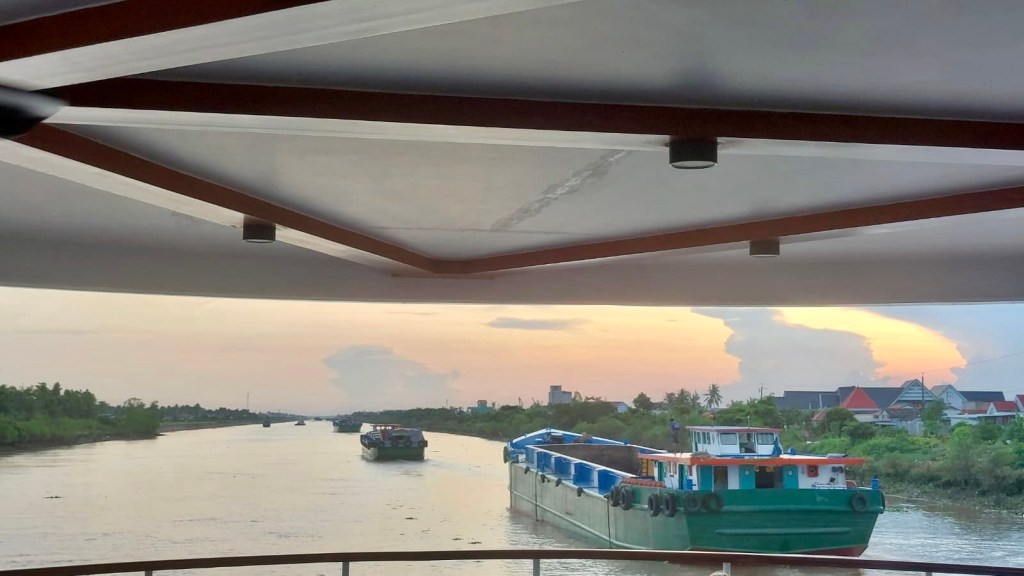
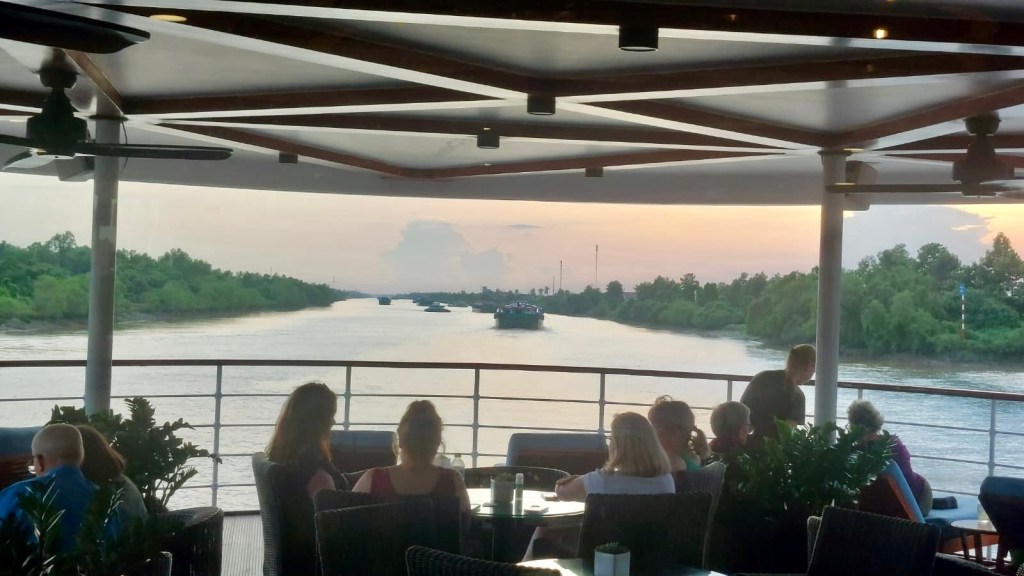
While the exterior is understated, the interior is beautifully appointed. One of our favorite features is the open-air lanai at the front of the ship, complete with lounge chairs and a true front-row seat to life along the river. Inside, the main lounge provides a welcome escape from the humid heat with air conditioning and a small bar. This versatile space serves as the daily meeting point for excursions, a gathering spot for evening cocktails, and the setting for onboard entertainment.
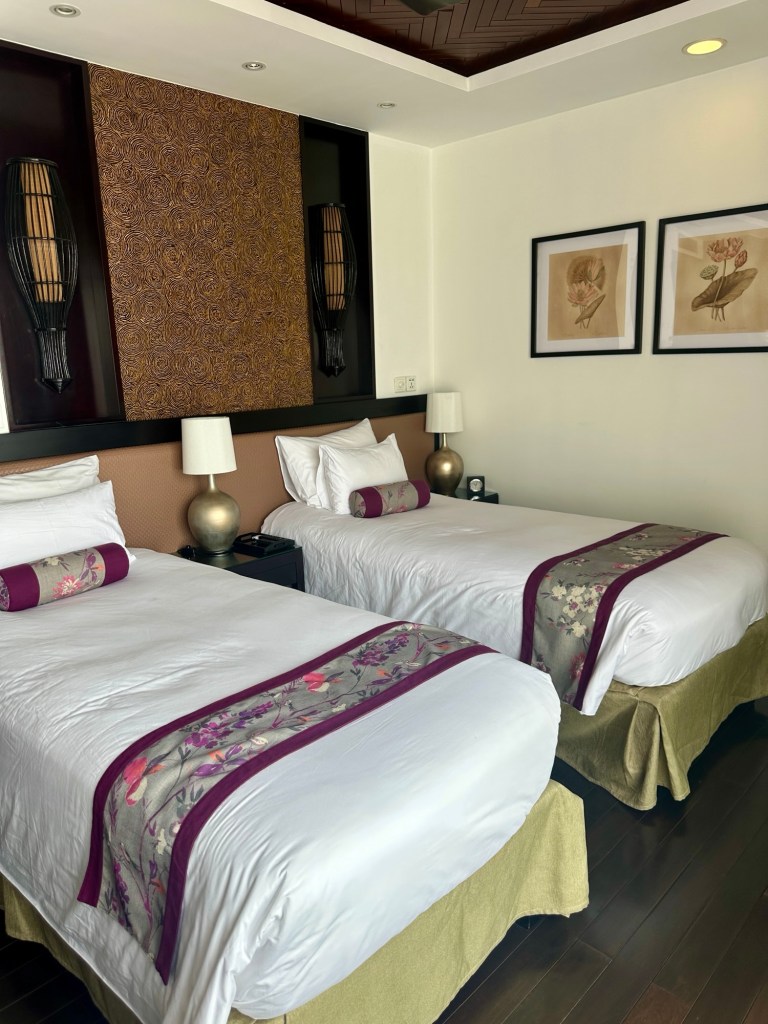
One of the main reasons we chose Avalon was the room design—and it exceeded expectations. The cabins feel spacious, with a comfortable seating area and desk. The bathrooms are impressively large and elegantly designed, but the standout feature is the bed placement. Positioned to face the window, you can relax and watch the shoreline drift by during an afternoon rest or quiet evening onboard.
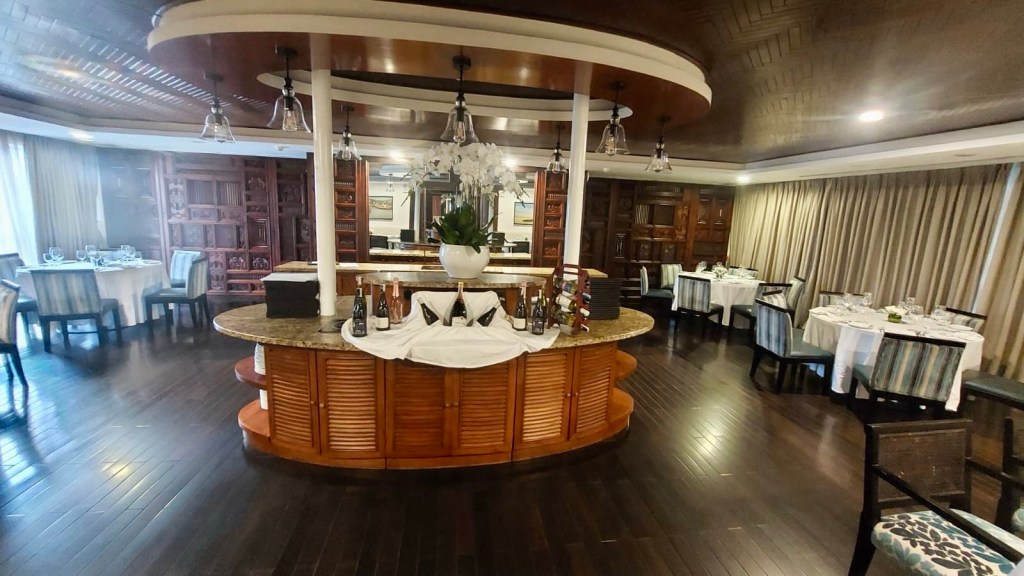
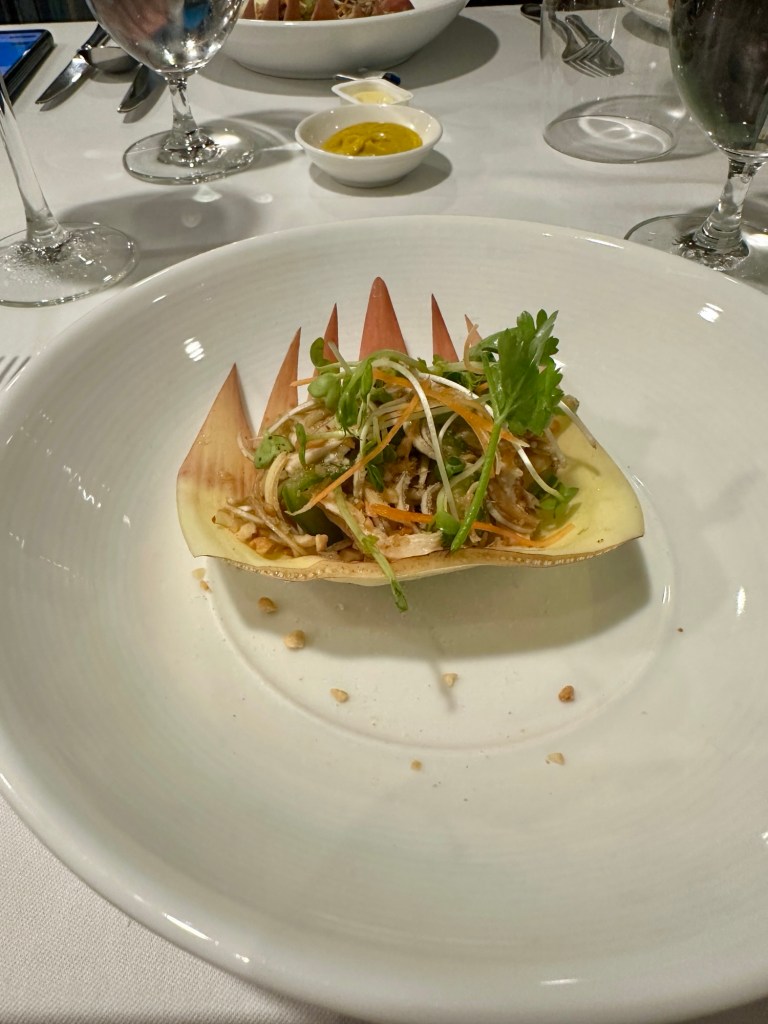
Because this is a small ship, it’s important to manage expectations when it comes to dining—but we were pleasantly surprised. The food is outstanding, prepared by talented chefs offering a variety of options, all served in a single dining room. Breakfast and lunch are buffet-style with an excellent selection, complemented by made-to-order stations offering rotating choices. Dinner is a seated, four-course experience with four to five menu options each evening. By the second day, the staff knew us by name and greeted us warmly wherever we were on the ship, adding to the sense of personalized service.
One of the aspects we appreciate most about Avalon is their all-inclusive model. Beer and wine are included at lunch and dinner, as are all excursions. There’s no nickel-and-diming—just thoughtfully curated experiences led by knowledgeable local guides who bring each destination to life.
Curious about what you’ll experience on a Mekong River Cruise? Read on for a day-by-day look at this unforgettable journey through the beautiful countries of Vietnam and Cambodia.
Arriving in Ho Chi Minh City
Whether you book your flights directly with Avalon or make your own air arrangements, Avalon ensures a seamless arrival experience. All guests are met at the airport and provided with transportation to the hotel. Avalon also offers pre-cruise extensions—either a week-long program beginning in Hanoi or a three-night stay in Ho Chi Minh City. We chose the Ho Chi Minh City pre-cruise extension featured here.
After clearing immigration, (plan on this taking up to an hour), our driver, Harry, was waiting to greet us. During the approximately 45-minute drive into the city, he provided colorful commentary and local insight, setting the tone for the days ahead. Shortly after arrival, we were also contacted by our cruise director, Mr. Pheim, who checked in to ensure we were comfortably settled and clear on the plans for the following day.
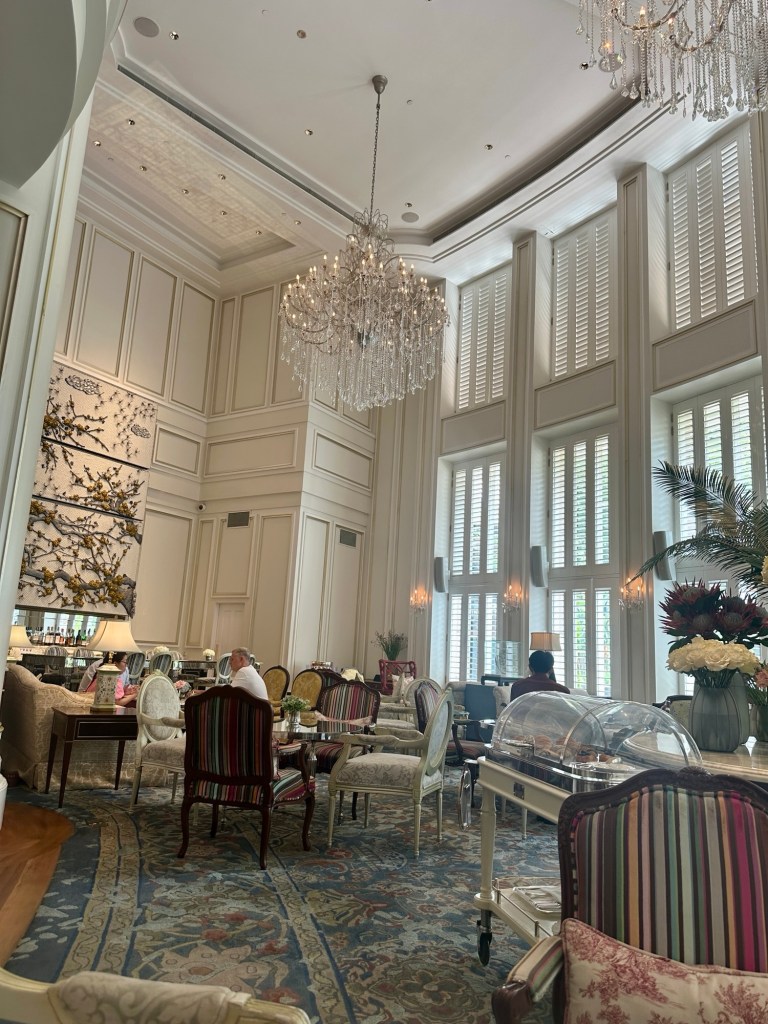
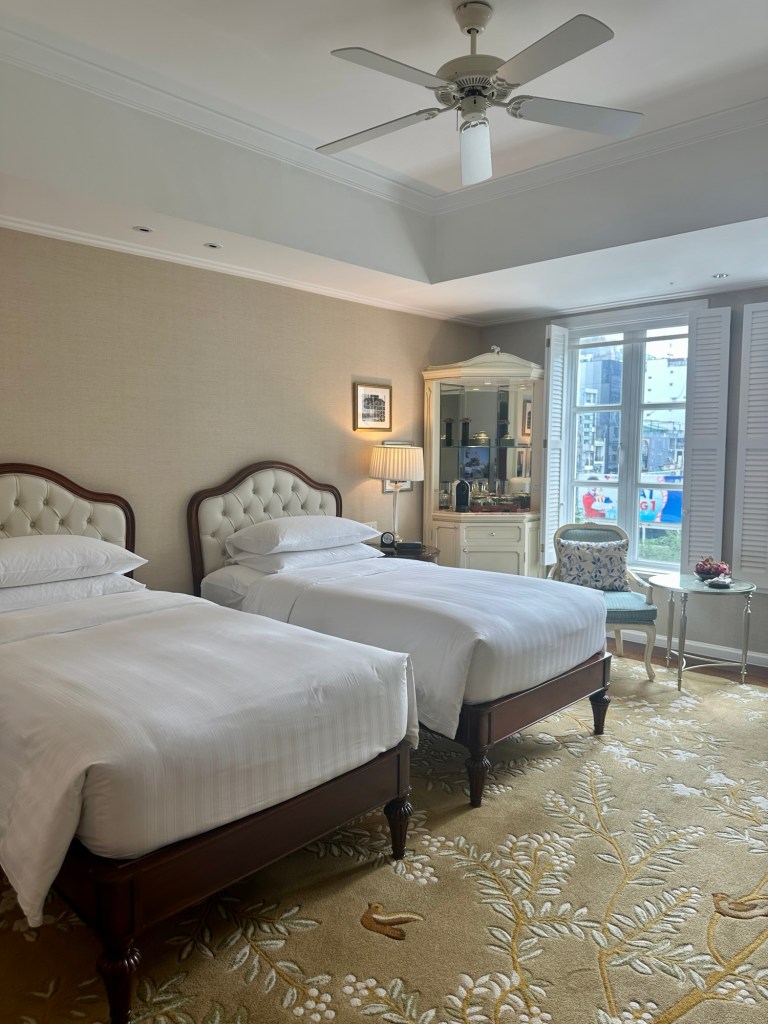
Our pre-cruise stay was at the Grand Park Hyatt, a stunning five-star hotel known for its impeccable service. The front desk staff were incredibly helpful—assisting with currency exchange, offering helpful directions, and even arranging an early check-in, which was especially appreciated after a long international journey.
Day 1: Vietnam
Ho Chi Minh (Saigon)
It’s common—and highly recommended—to arrive at least one day before your ship embarks. This allows time to acclimate after a long international flight and provides a buffer for any potential delays. Most flights arrive in the morning, giving you a full day to begin exploring the city.
The Grand Park Hyatt, arranged by Avalon, is ideally located in a modern, upscale area near the banking district, making it a comfortable and convenient base for your first night in Vietnam. While the official name is Ho Chi Minh City, many locals—particularly in the south—still prefer to call it by its original name, Saigon, a reflection of the city’s layered history and identity.
That evening, Avalon hosted a welcome dinner at Vietnam House, where we enjoyed authentic Vietnamese cuisine and our first official taste of the culture, flavors, and hospitality that would define the journey ahead.
Day 2: Vietnam
Embarkation Day
Avalon provides motor coach transportation from the hotel to the port, a short and easy drive of about 15 minutes. Locally, the Mekong River is often referred to as the Nine Dragon River, a name inspired by the river’s nine branches as it flows through the delta.
Avalon’s commitment to sustainability is evident from the moment you step onboard. Each guest receives a reusable water bottle, with chilled water refill stations located throughout the ship—an intentional effort to reduce single-use plastic. Equally noticeable is the care taken to preserve the ship itself. After excursions or time spent ashore, guests are welcomed back with a refreshing cold towel and a small juice, then kindly asked to remove their shoes so they can be cleaned. This thoughtful practice helps prevent rocks, grit, or mud from damaging the ship’s beautiful wood floors. Shoes are typically returned to your cabin door within 30 minutes.
On embarkation day, lunch is served as the ship quietly casts off for a scenic six-hour sail to Vinh Long. The ship anchors there overnight, perfectly positioned for two immersive excursions scheduled for the following day.

Day 3: Vietnam
Vinh Long Rice Paper
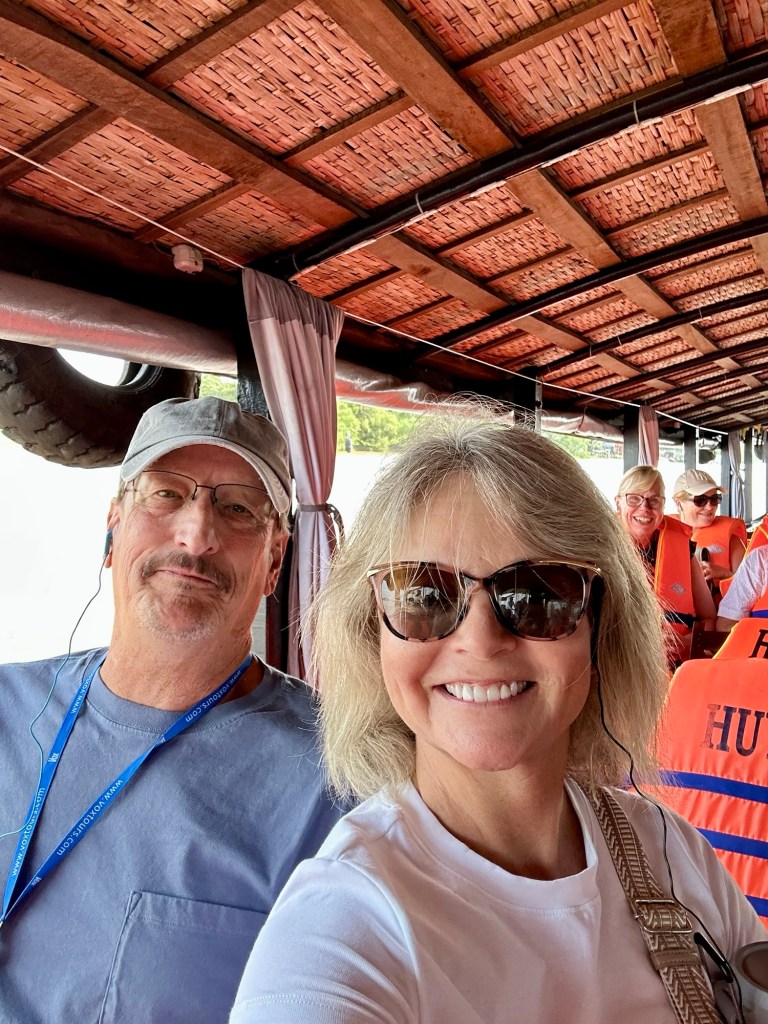
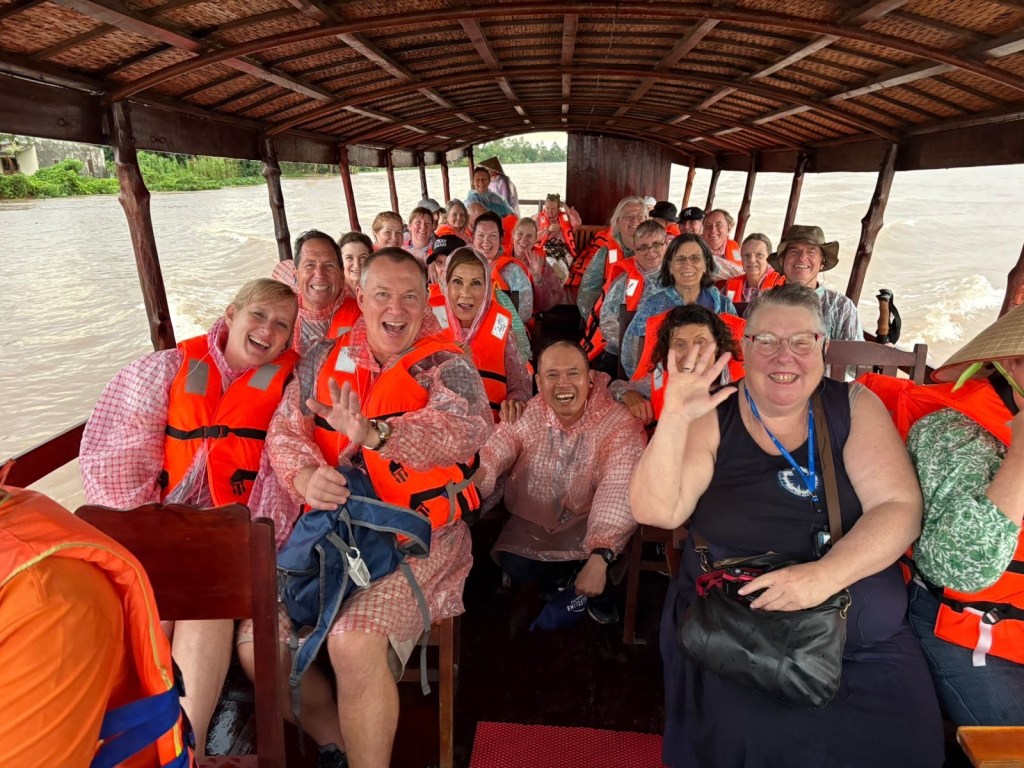
The morning excursion begins by sampan boat to the community of Vinh Long. The sampan comfortably accommodates all 31 guests and offers an up-close, intimate view of daily life along the river as you travel to your destination.
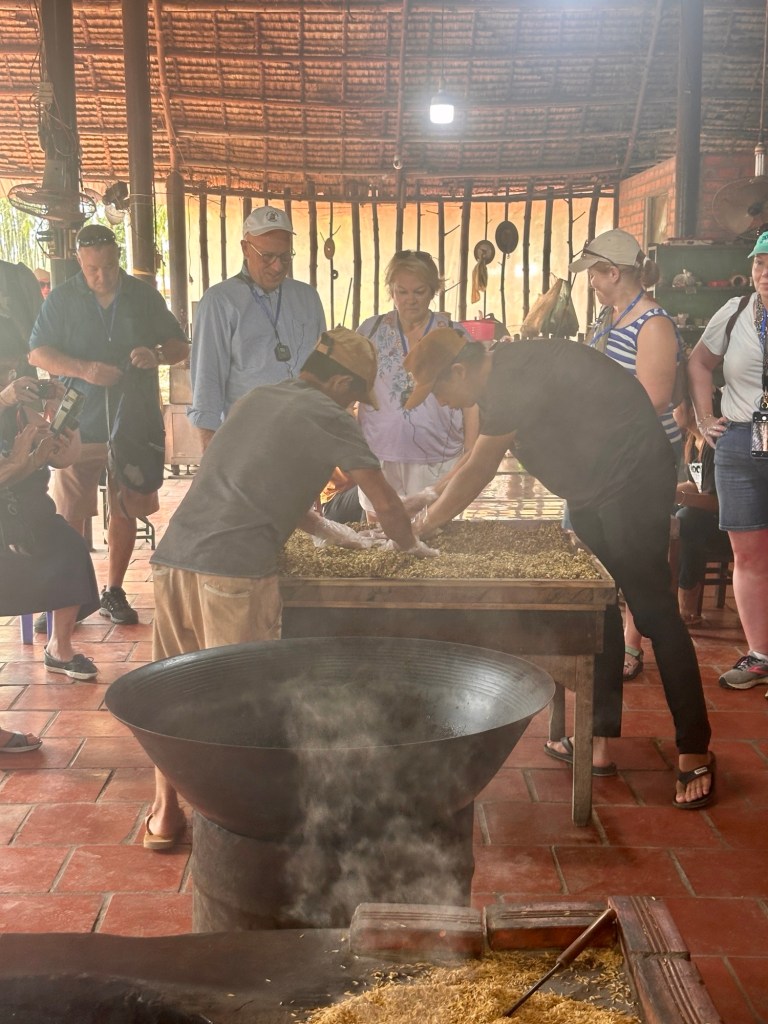
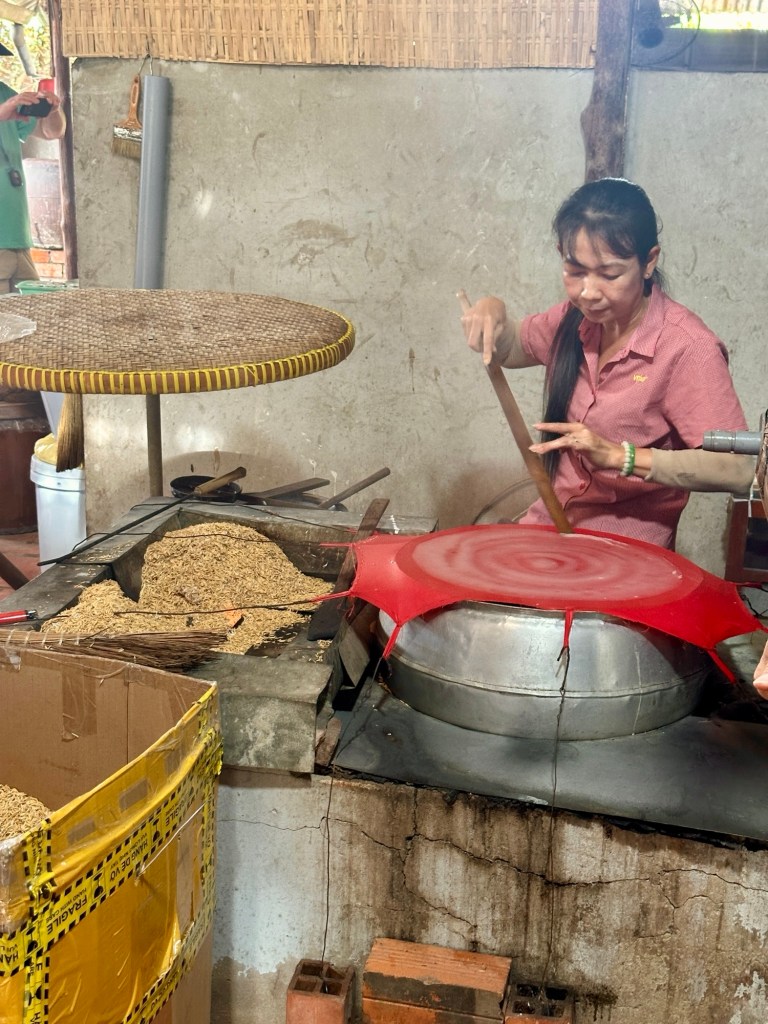
After disembarking, we visited a collection of open-air structures where multiple local families work side by side practicing traditional trades. We observed the making of rice paper (the edible kind, not for writing), popped rice, and coconut toffee. This stop also provided an opportunity to shop for the very items being demonstrated.
Guests are encouraged to purchase something small to support these local families. With the favorable exchange rate, most items cost just $2–$4—an insignificant amount for visitors, but meaningful support in an economy where the average monthly income ranges from $200 to $400.

Cu Lao Gieng Island Conical Hats
Avalon is very thoughtful about pacing, ensuring there’s built-in rest time between excursions. After returning from the morning’s activities, we enjoyed lunch onboard while the ship sailed approximately four hours downriver to Cu Lao Gieng Island.
Once docked, we boarded sampans and walked through a lush, jungle-like neighborhood to visit a family of women who handcraft traditional Vietnamese conical hats. This painstaking work is a dying art, and their skill was remarkable to witness. Each hat is made entirely by hand, with the women producing only about four hats per day. Despite the labor involved, each hat sells for roughly 100,000 VND (about $5 USD). Supporting these artisans felt like an easy and meaningful choice.
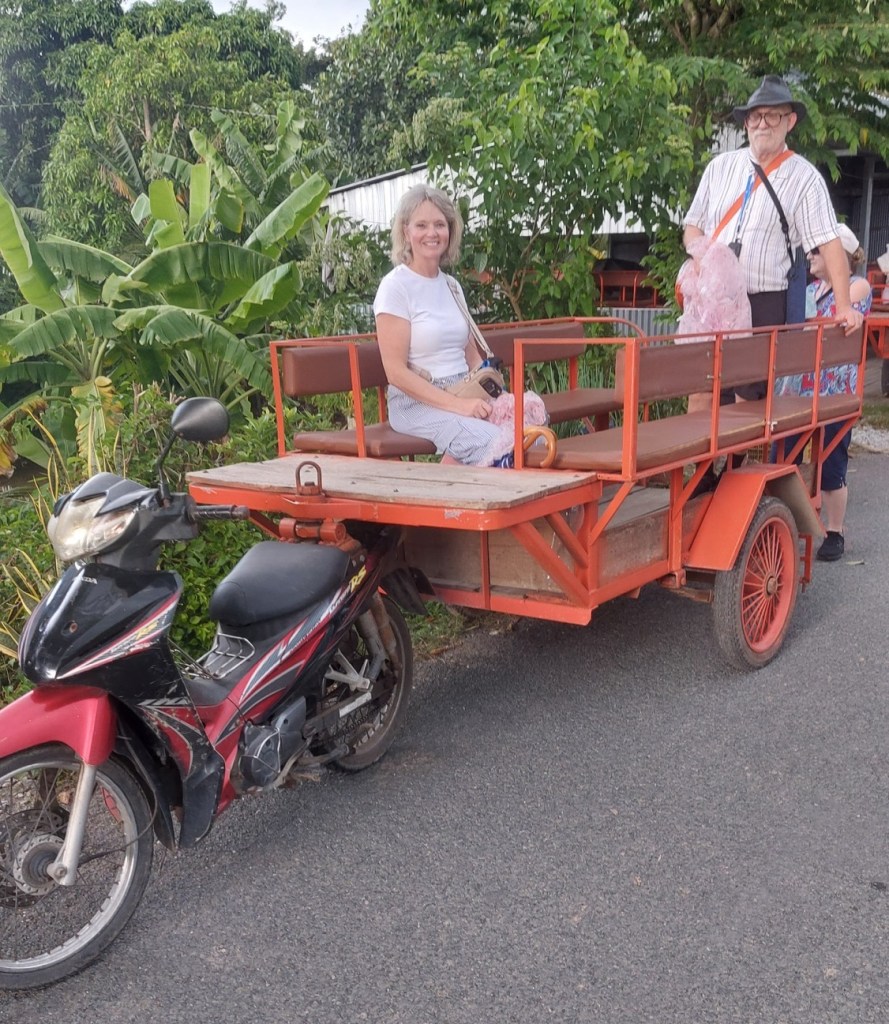
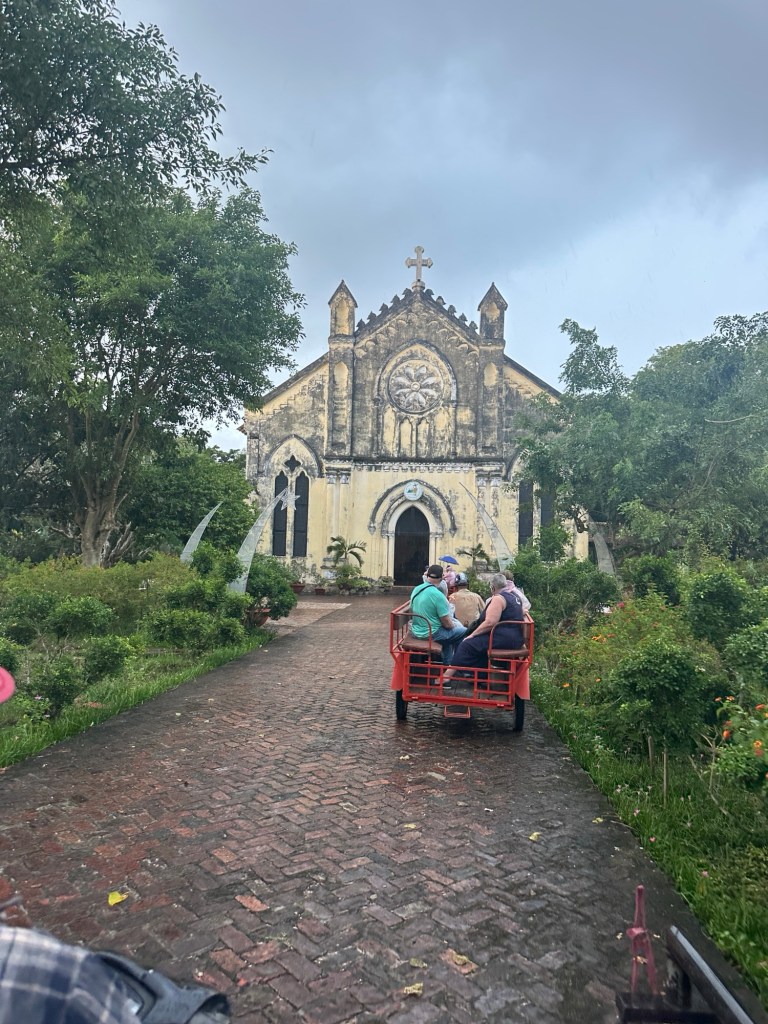
Our final stop for the day took us across the island by tuk tuk, weaving through mango groves on the way to a Catholic monastery. Catholicism was introduced to Vietnam during the French colonial period, and today about 10% of the population practices the faith. Travelers should always be prepared for the possibility of rain in Vietnam, and just before an afternoon downpour, we were thoughtfully provided with rain ponchos—an addition that only enhanced the sense of adventure.
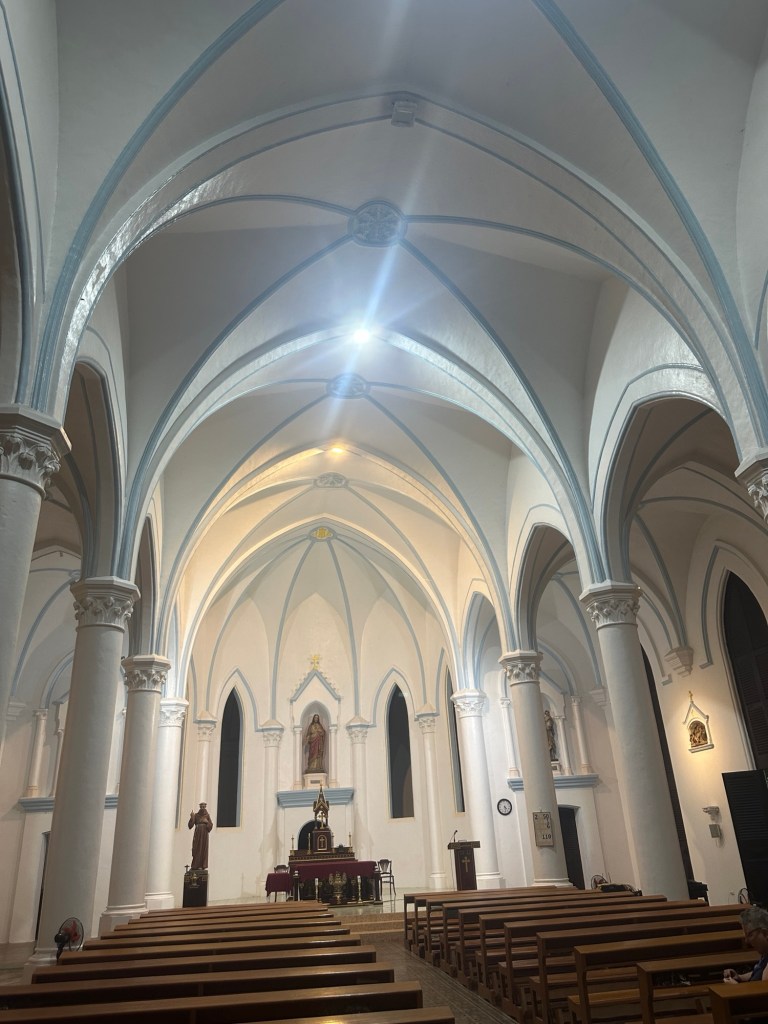
We spent time in the Chapel of the Sacred Heart and had the opportunity to speak with a Franciscan friar who is also a physician specializing in leprosy. The monastery itself is 153 years old, and the experience offered a powerful glimpse into the island’s spiritual, historical, and humanitarian legacy.

Day 4: Vietnam
Chau Doc Wet Market & Canals of Mekong
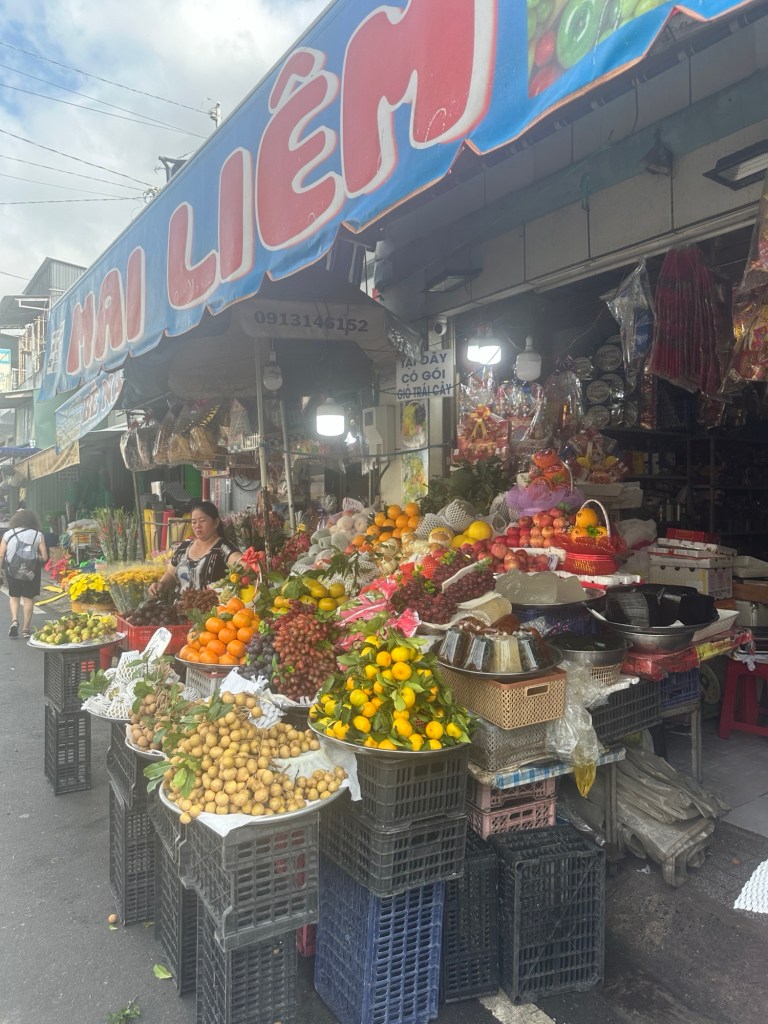
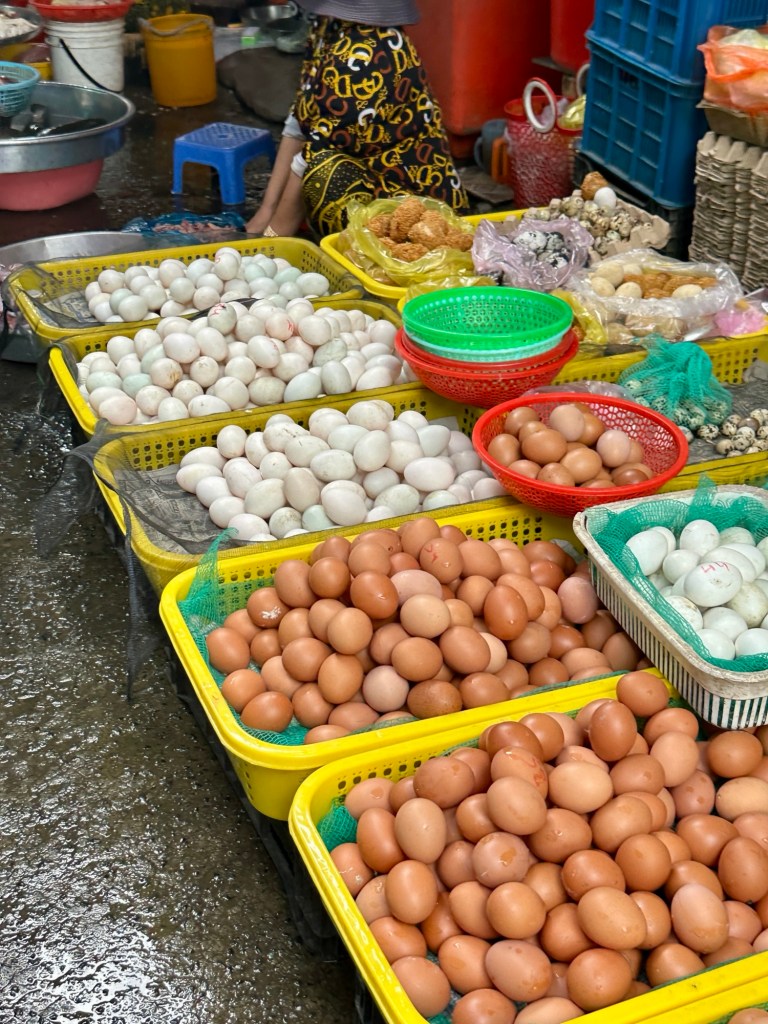
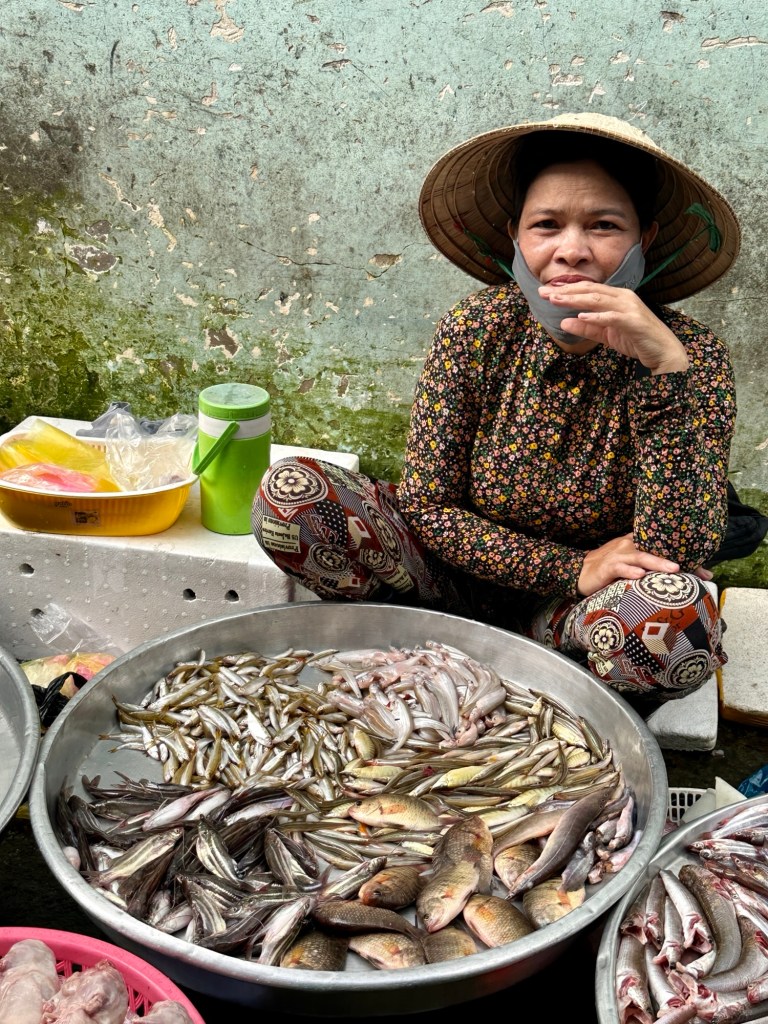
The true value of international travel lies in learning about different people and cultures with an open mind—and nowhere is that more apparent than at a local wet market. This is where families shop for everything needed for daily cooking, offering a raw and unfiltered glimpse into everyday life.
Meats and fish are unrefrigerated, and fruits and vegetables are rinsed in Mekong River water—conditions that local residents are accustomed to, but which Western travelers are not. For visitors, it’s best to observe rather than touch or sample. Among the most surprising sights were skinned rice paddy rats, prepared for cooking. In a country that has endured deep poverty, this reflects the ingenuity and resilience of people who use every available resource to feed their families.

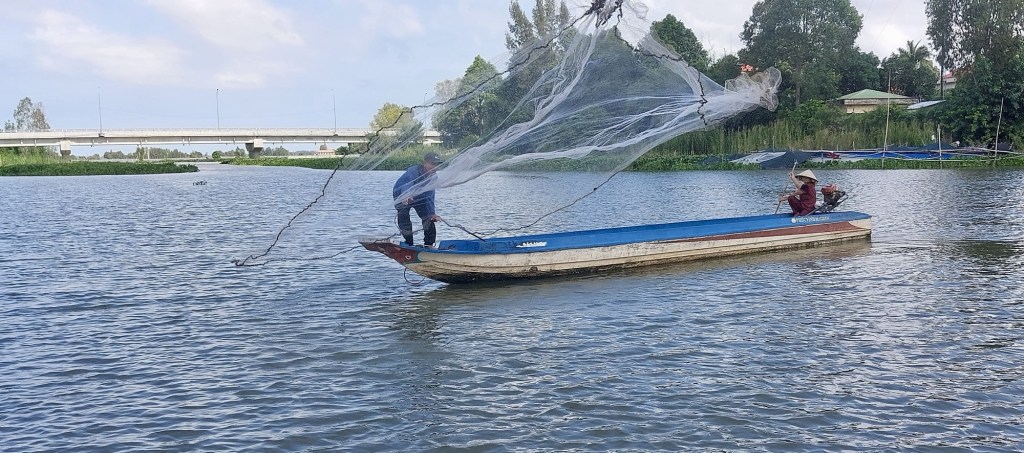
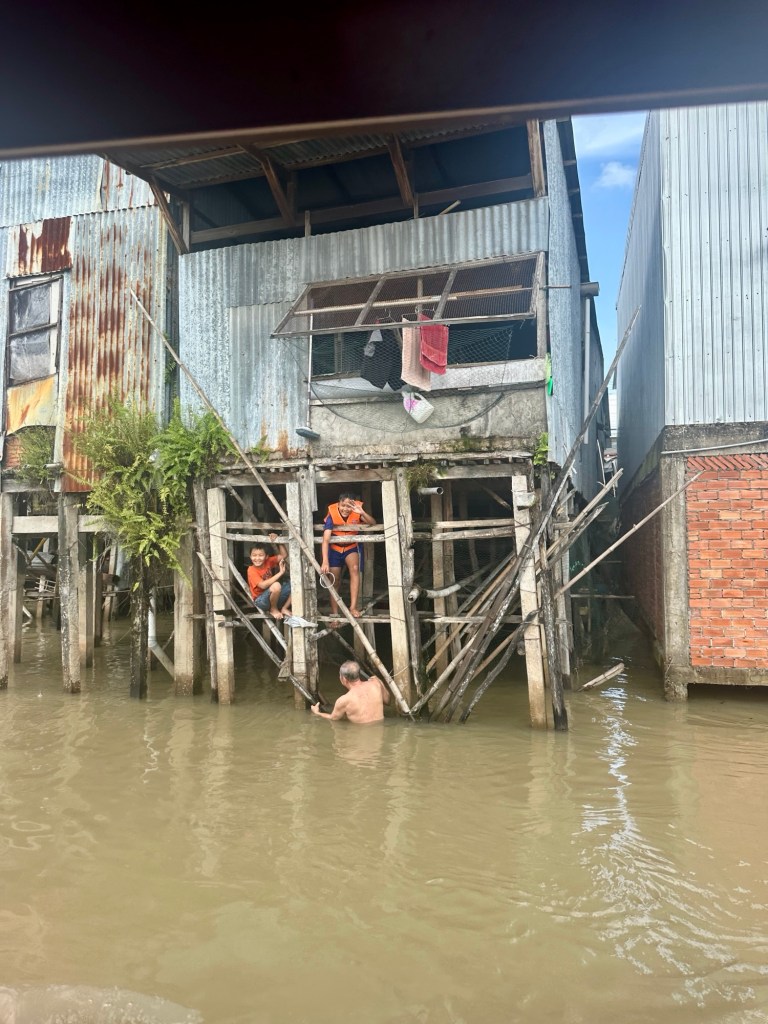
After leaving the market, we boarded sampans for a two-hour round-trip journey through a man-made canal. Along the way, we passed homes built on stilts above the water or tucked alongside rice paddies—designed to accommodate the seasonal rise in water levels during the rainy season. Interestingly, locals welcome the rising waters, as flooding helps eliminate insects and rodents that would otherwise damage crops.
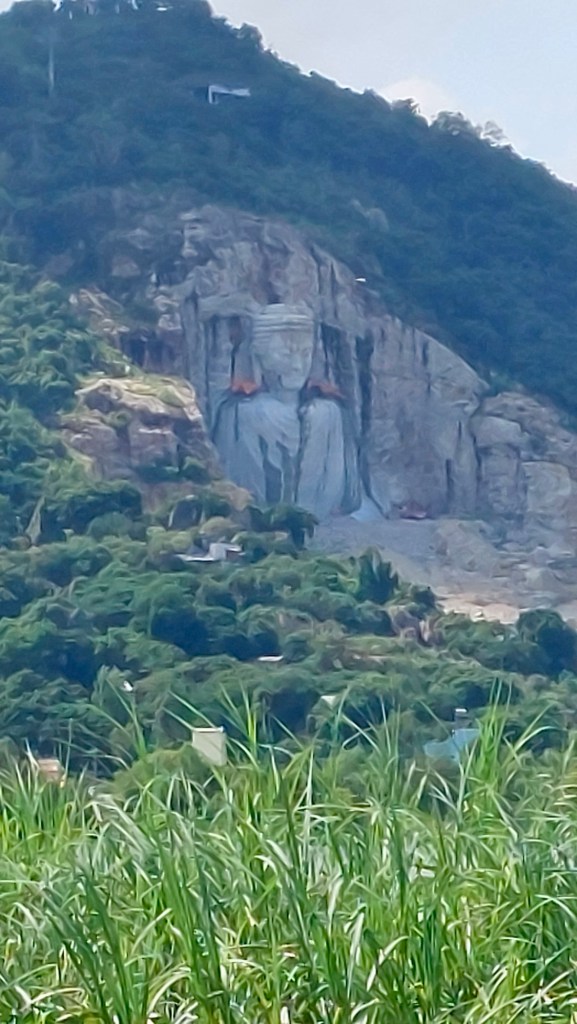
Nearly a mile into the canal, we came upon a massive Buddha carved directly into the mountainside—the second largest of its kind in the world. The mountain itself is also known for its king cobra dens, adding a sense of awe and respect to the setting.
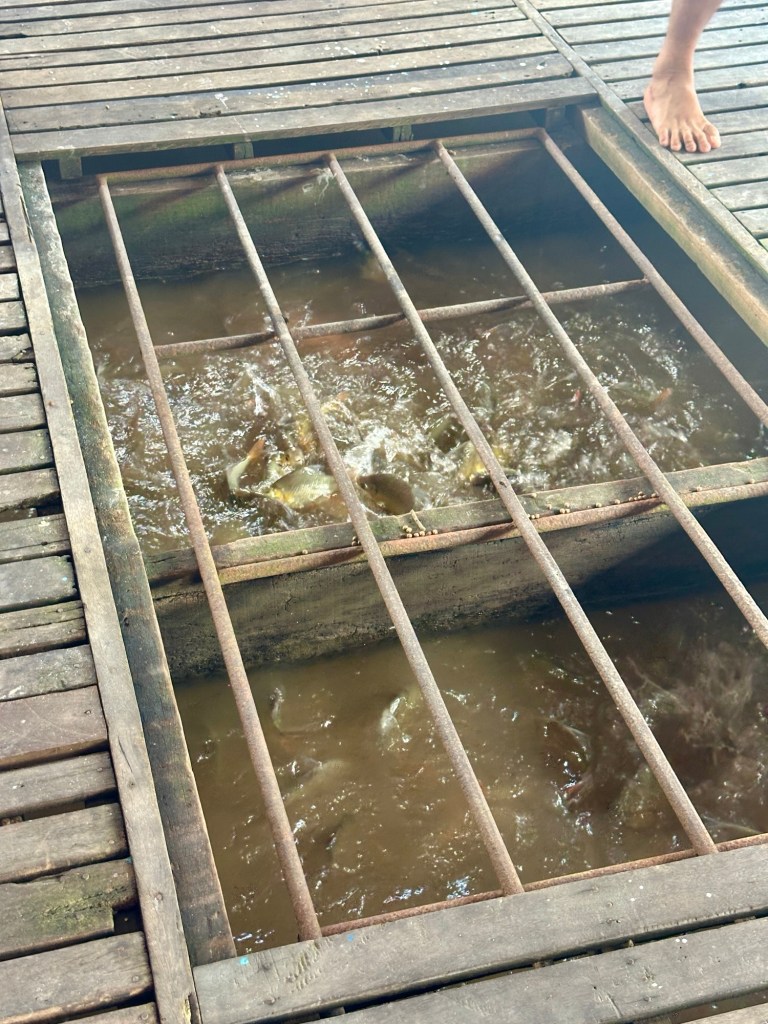
Before returning to the ship, the sampan made one final stop at a floating fish farm. Here, we learned about the local aquaculture industry, including the farming of catfish and pomfret fish for market—another example of how closely life in the Mekong Delta is tied to the river.
Village of Long Khanh A Cotton Weaving
After lunch, our sampan followed the shoreline to the small village of Long Khanh A. A walking tour through the village immediately felt more rural and agricultural than the other communities we had visited.
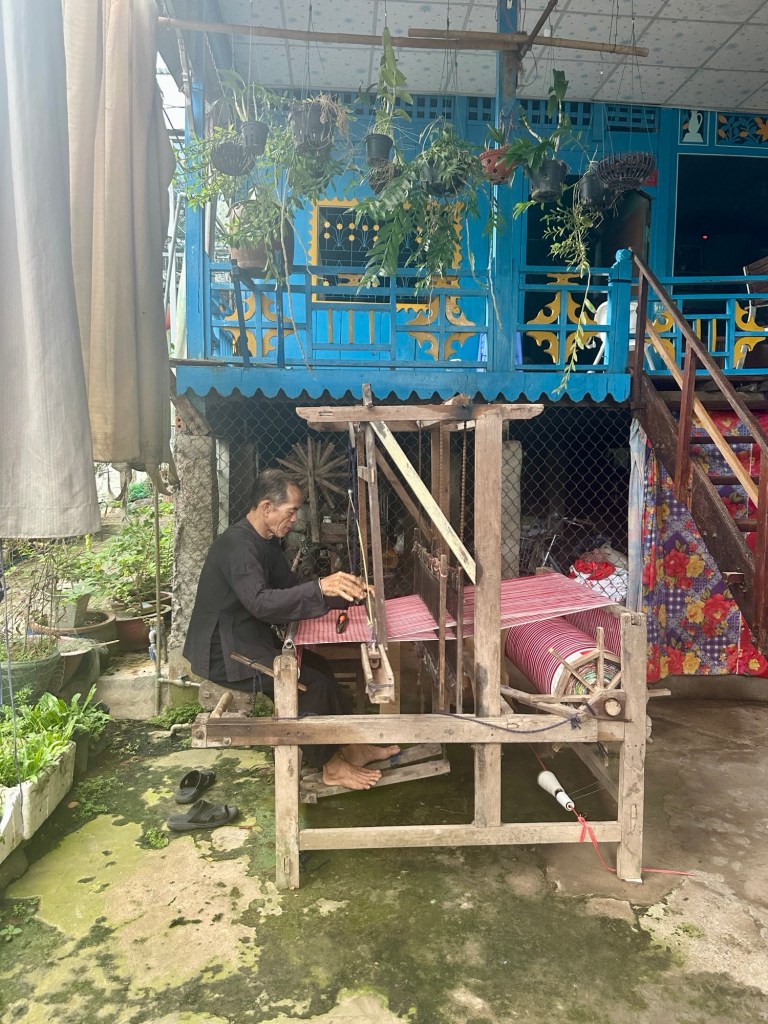
As we made our way through the village, we arrived at the home of a family of third-generation weavers. This village has been known for weaving for hundreds of years, though the artisans transitioned from silk to cotton when they could no longer compete with large-scale production from China. Throughout the Mekong Delta, each village—or even each family—tends to focus on producing or selling a single specialty. These skills are passed down through generations, preserving both tradition and livelihood.
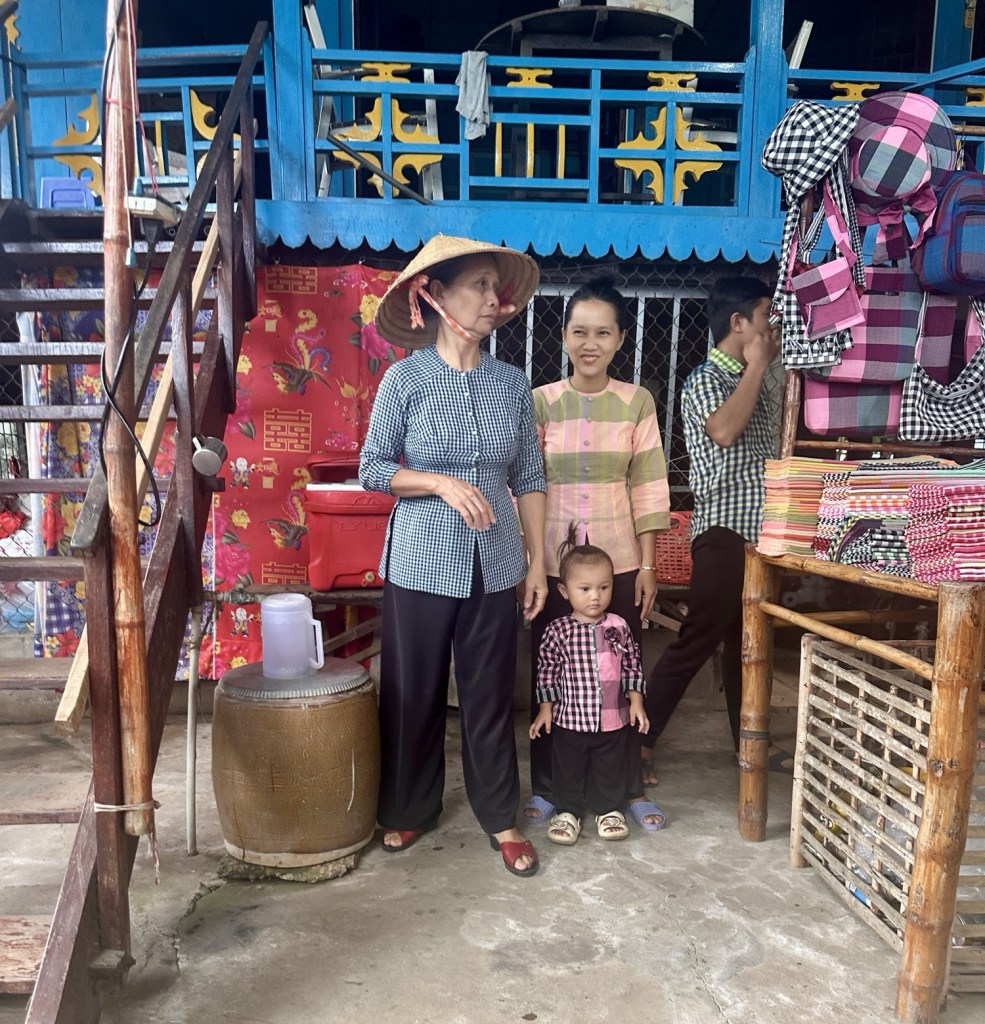
That evening, we said goodbye to our wonderful Vietnamese guide, Sai, who could not continue with us across the border into Cambodia. His warmth, knowledge, and insight added tremendous depth to our time in Vietnam, and we were grateful for the experiences he helped bring to life.
Day 5: Cambodia
Phnom Penh The Royal Palace & Museum
After breakfast, we ventured into Phnom Penh by cyclo—individual rickshaws pedaled by bicycle—for a scenic and relaxed ride through the city to the Royal Palace.
Built between 1917 and 1920, the Royal Palace marked the relocation of Cambodia’s king and royal residence to Phnom Penh from Angkor. The palace complex is an elegant blend of traditional Khmer and French colonial design. Atop the palace spire are four faces representing the king and symbolizing the four elements. Photography is not permitted inside the palace grounds, preserving the sanctity of the space.
Within the complex is the Silver Pagoda, named for its floor made of thousands of silver tiles. Built as a temple for the royal family, it houses sacred Buddha statues and serves as a place of worship rather than a public shrine. As with the palace, photography is not allowed, and visitors are required to remove shoes and hats before entering—a sign of respect that reinforces the spiritual significance of the site.
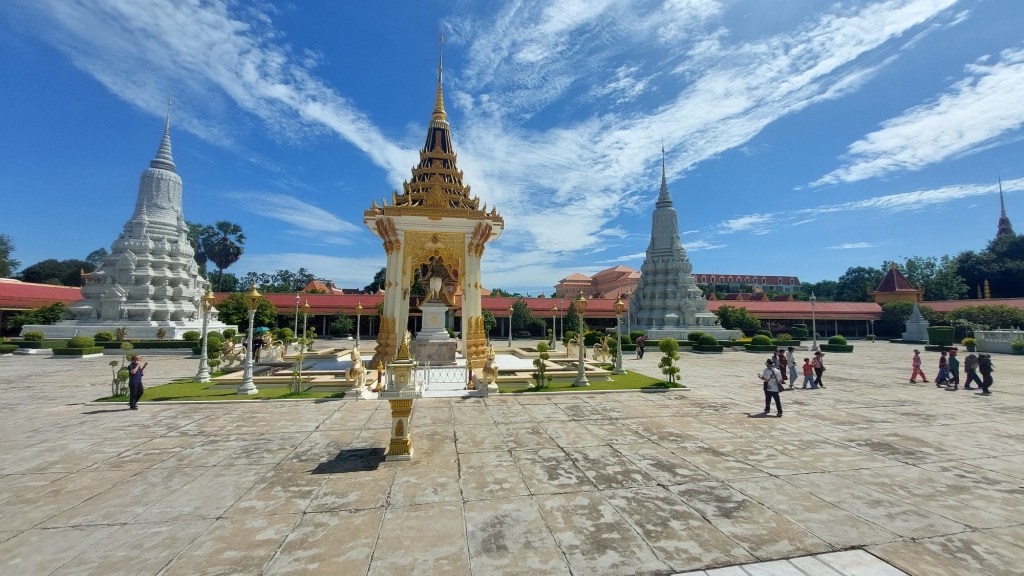
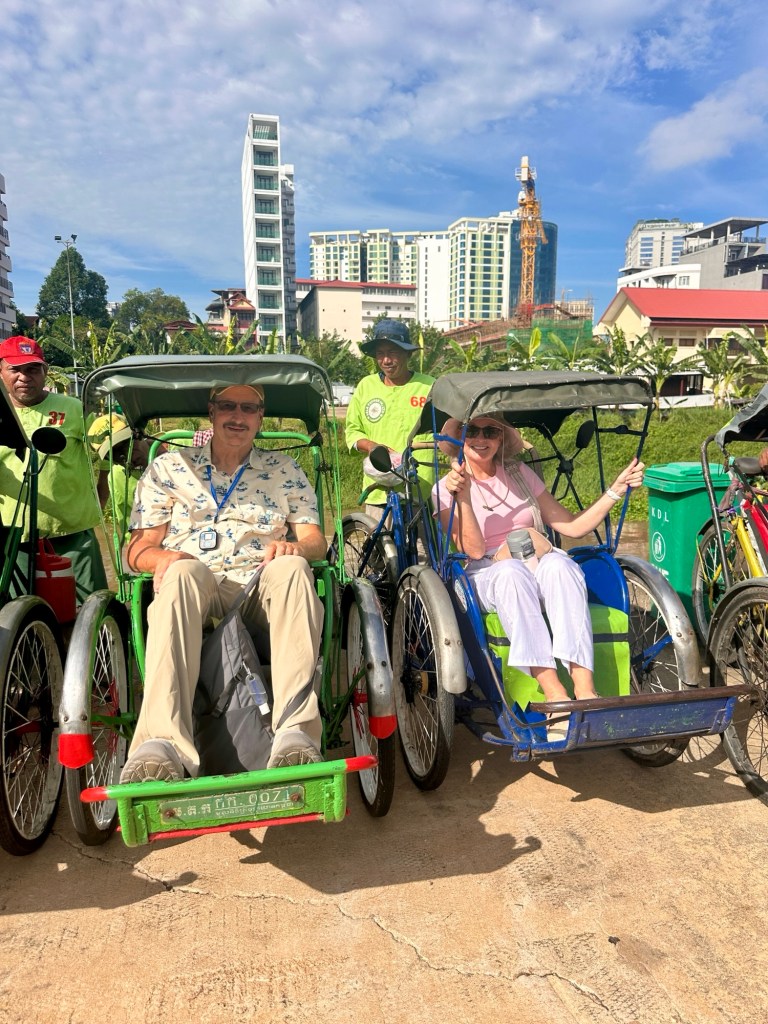
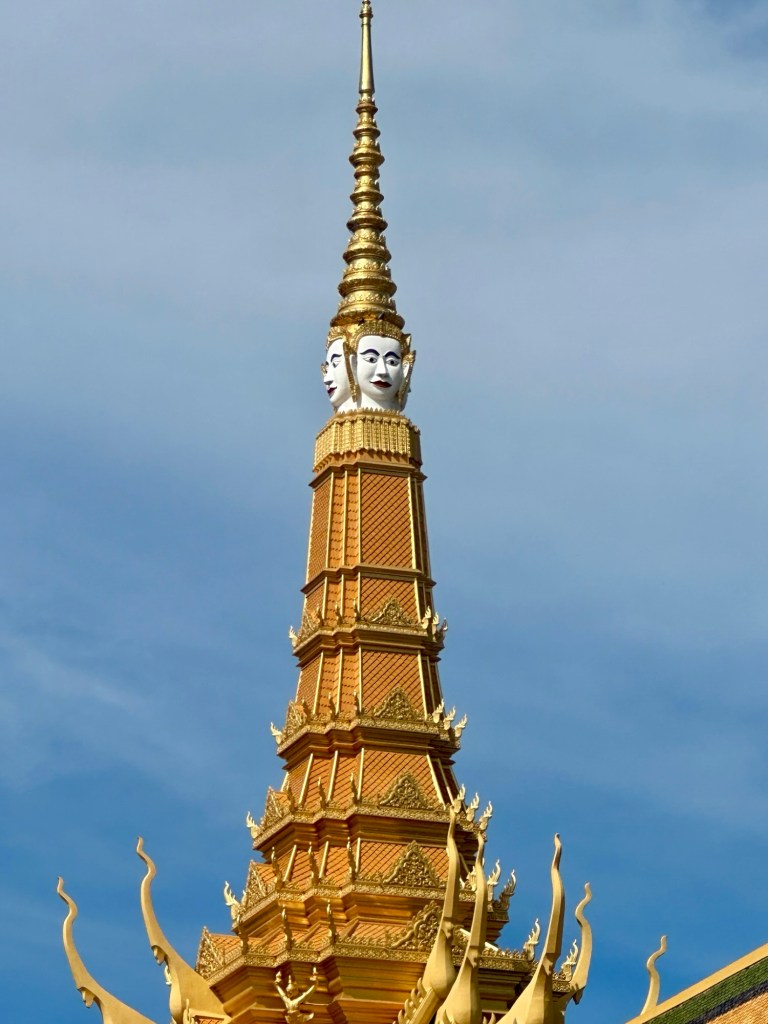
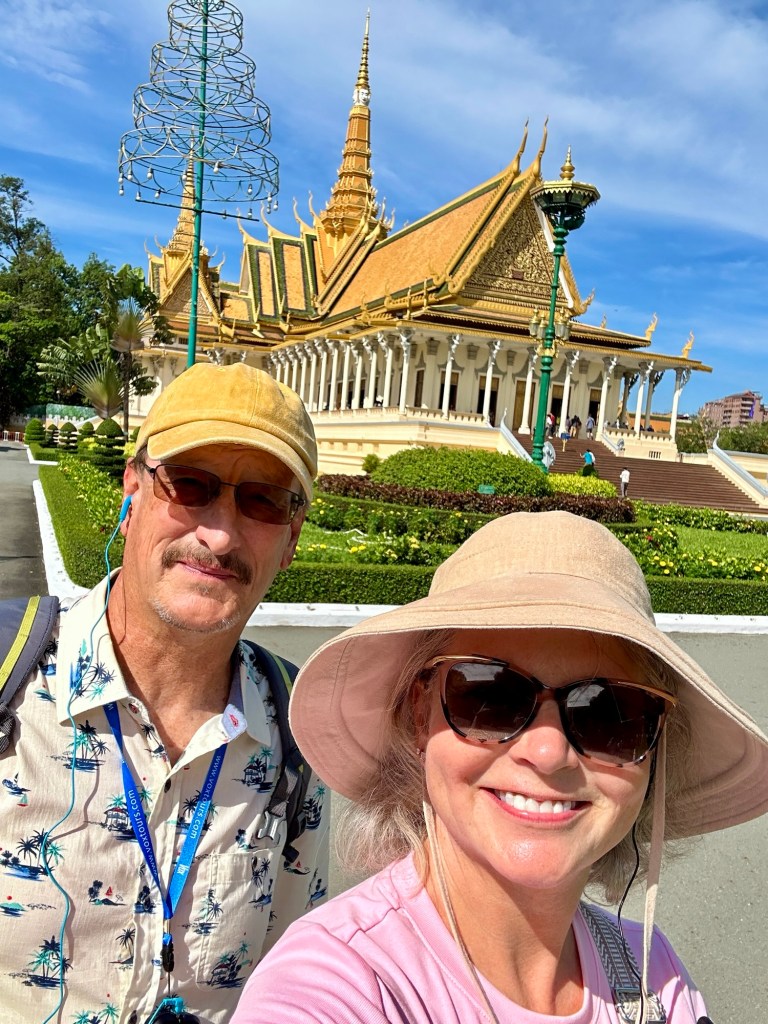
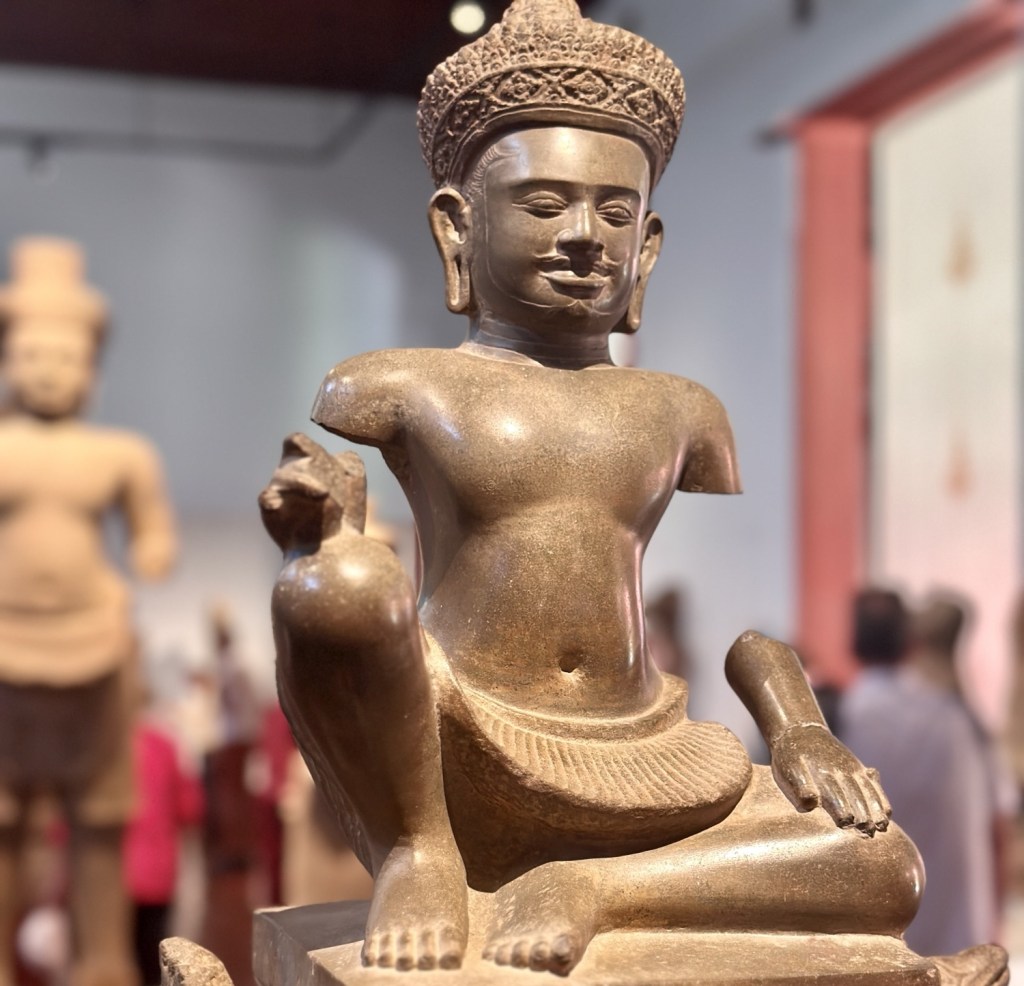
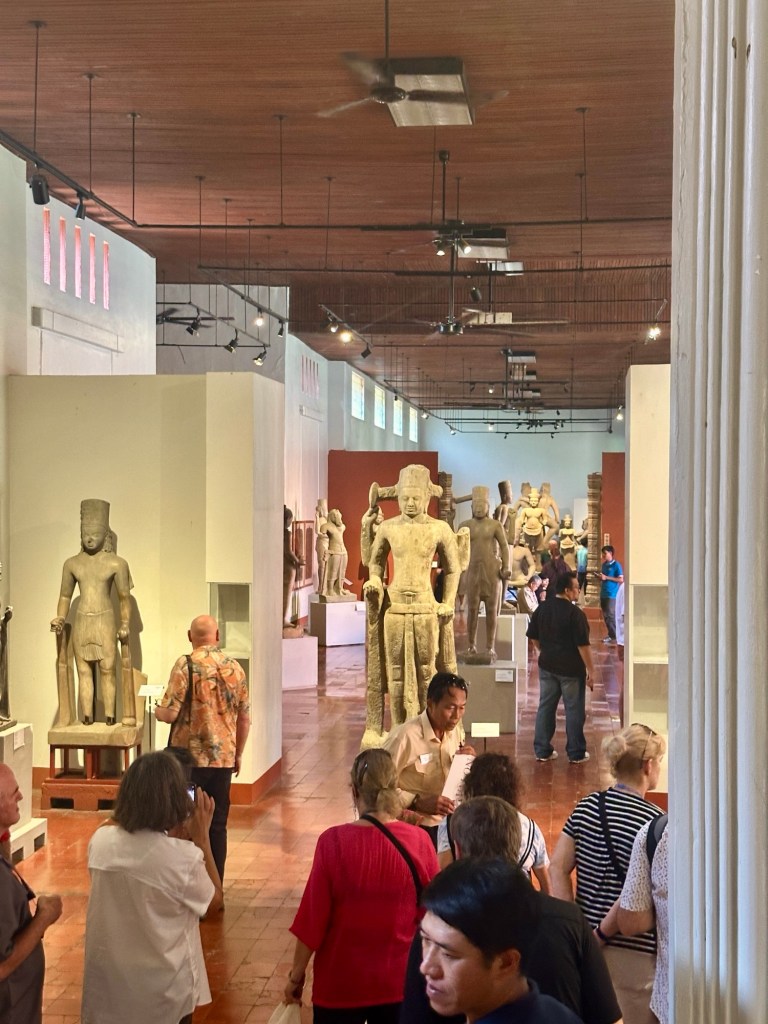
Following our palace visit, the cyclo ride continued to the Cambodian National Museum. The museum’s collection is primarily composed of Buddha and Vishnu statues, offering a fascinating look at the evolution of Khmer art across centuries. As you move through the galleries, you can clearly see changes in facial expressions, posture, and craftsmanship—reflecting shifts in religious influence, artistic style, and cultural priorities over time. Figures such as Garuda, the mythical half-man, half-bird protector deity, appear throughout the exhibits, highlighting the deep connections between Hindu and Buddhist traditions in Cambodia’s history.
Evening Dinner Entertainment
Cambodia is home to hundreds of orphanages, many of which were established in the aftermath of decades of conflict, including the Khmer Rouge era and the legacy of the Killing Fields. While that history plays a role, it’s important to note that many children living in orphanages today are not true orphans. Poverty, lack of access to education, and economic hardship often lead families to place children in institutional care in hopes of providing them with better opportunities.
Avalon actively supports a local orphanage as part of its commitment to responsible tourism. Their involvement goes beyond financial contributions—they have invested in meaningful improvements, including upgrades to the girls’ dormitory and the purchase of a tuk tuk to help with transportation needs.
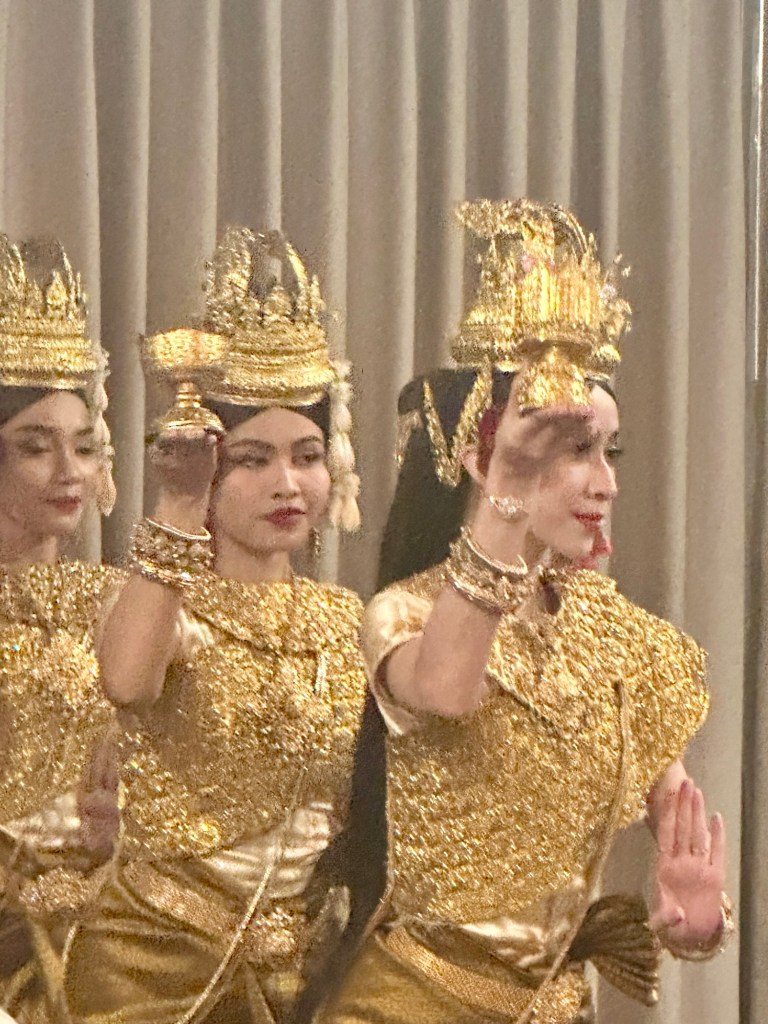
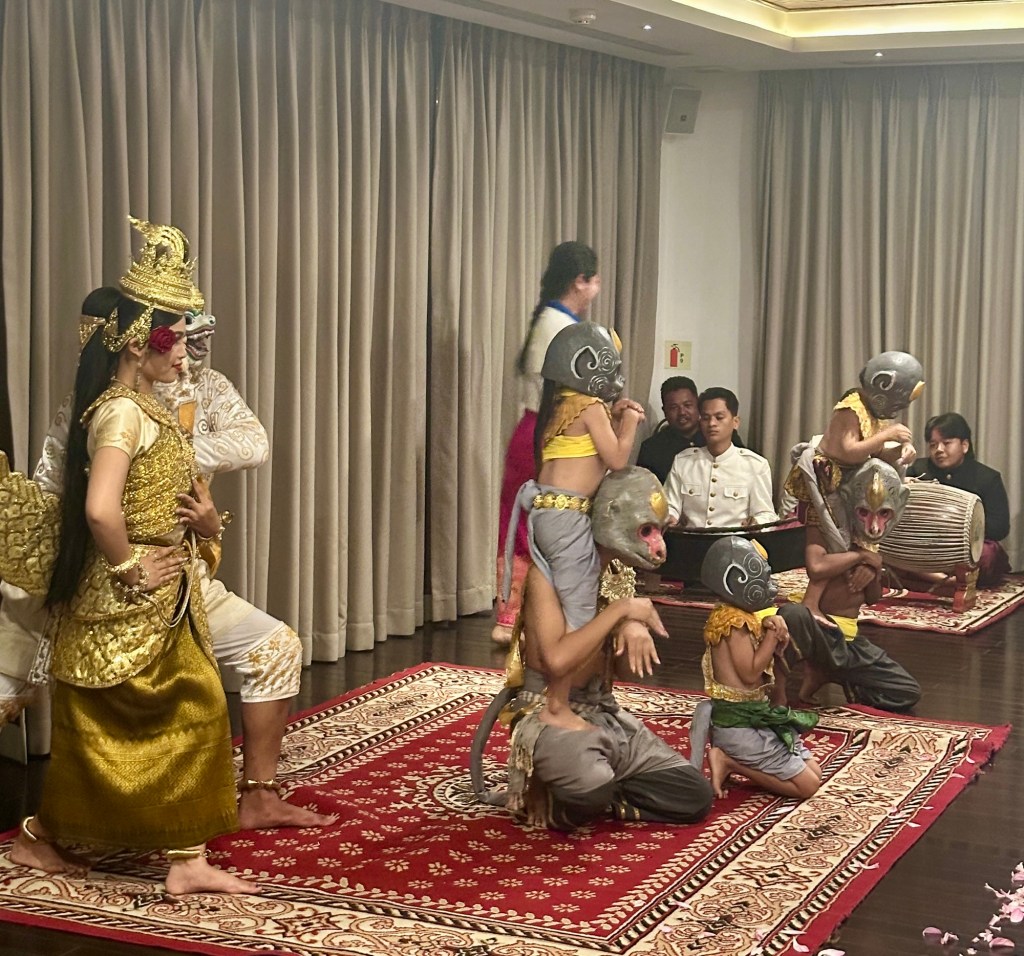
Several of the children visited the ship and performed traditional Cambodian dances for us, a moving and joyful experience. Each child introduced his or herself, sharing dreams of becoming doctors, lawyers, and accountants. Their instructor proudly explained that many of the children go on to attend university—a powerful reminder of the impact education, stability, and community support can have on shaping brighter futures.
Day 6: Cambodia
Security Prison “S-21”
Today was a solemn day, but an important one. Travel isn’t only about beauty and comfort—it’s also about understanding history, even when it is difficult. Only by acknowledging the past can we hope to learn from it. Today’s focus was on the Khmer Rouge, whose brief but brutal rule resulted in the genocide of nearly two million Cambodian people.
The site we visited was originally Tuol Svay Prey High School, before being converted by the Khmer Rouge into Security Prison 21 (S-21). Between 1976 and 1979, under the leadership of Pol Pot, an estimated 14,000 to 20,000 people were imprisoned here. Very few survived. This was one of 189 prisons spread across Cambodia during that period.
Walking through the former classrooms and seeing the faces of those who were lost was deeply sobering. While this visit may be emotionally difficult for some, we felt it was an important act of respect—to bear witness, to remember, and to better understand the resilience of the Cambodian people we have encountered throughout this journey.
The Killing Fields
Next, we boarded a coach and traveled about 30 minutes outside the city to visit one of the Killing Fields, now preserved as a memorial. The term “Killing Fields” refers to the many sites across Cambodia where mass executions and burials took place during the Khmer Rouge regime.
Collectively, more than 1.3 million people were killed and buried at these sites—nearly a quarter of Cambodia’s population at the time. Victims included men, women, children, and even infants. Executions often occurred at night, and in many cases blunt tools were used in an effort to conserve ammunition. The scale of loss is difficult to comprehend.
Out of respect, we chose not to take many photographs. We did document portions of the memorial constructed by the Cambodian government, as well as areas of the burial grounds, as a quiet acknowledgment of the lives lost. It was a deeply moving visit—one that reinforced the importance of remembrance, understanding, and honoring Cambodia’s history with humility.
Day 7: Cambodia
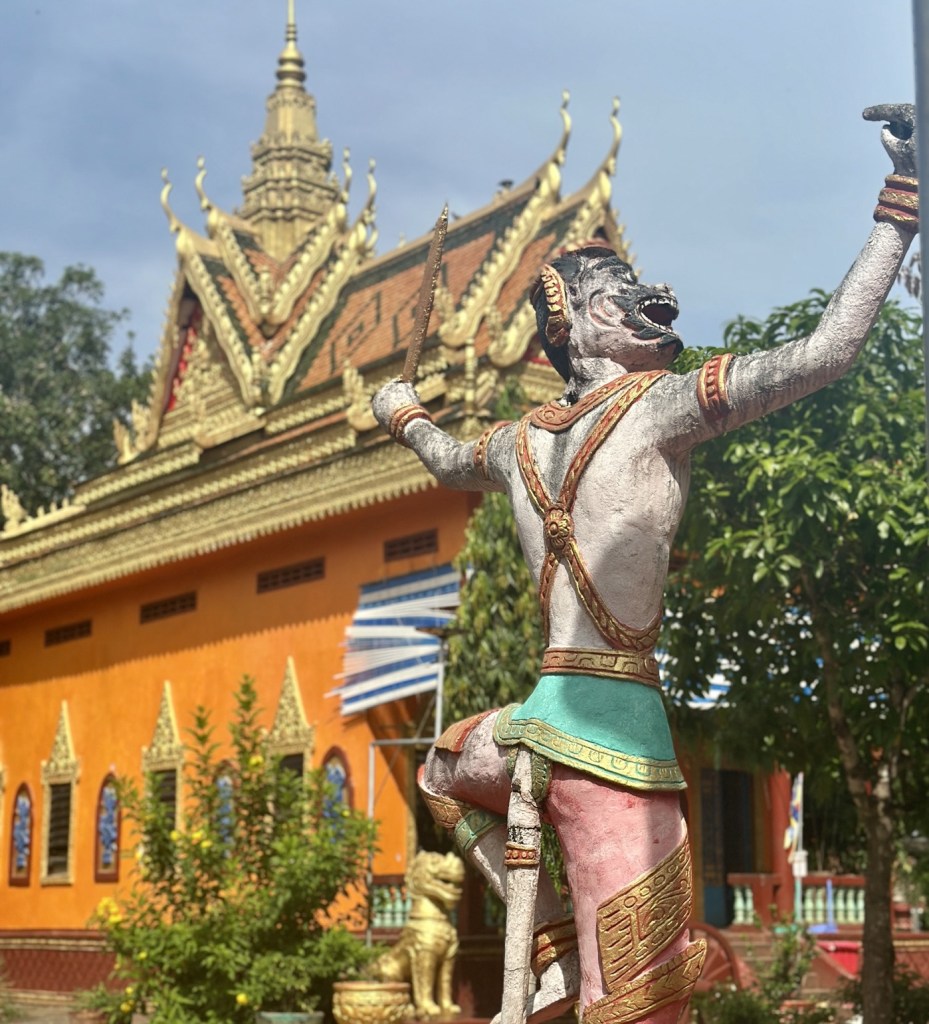
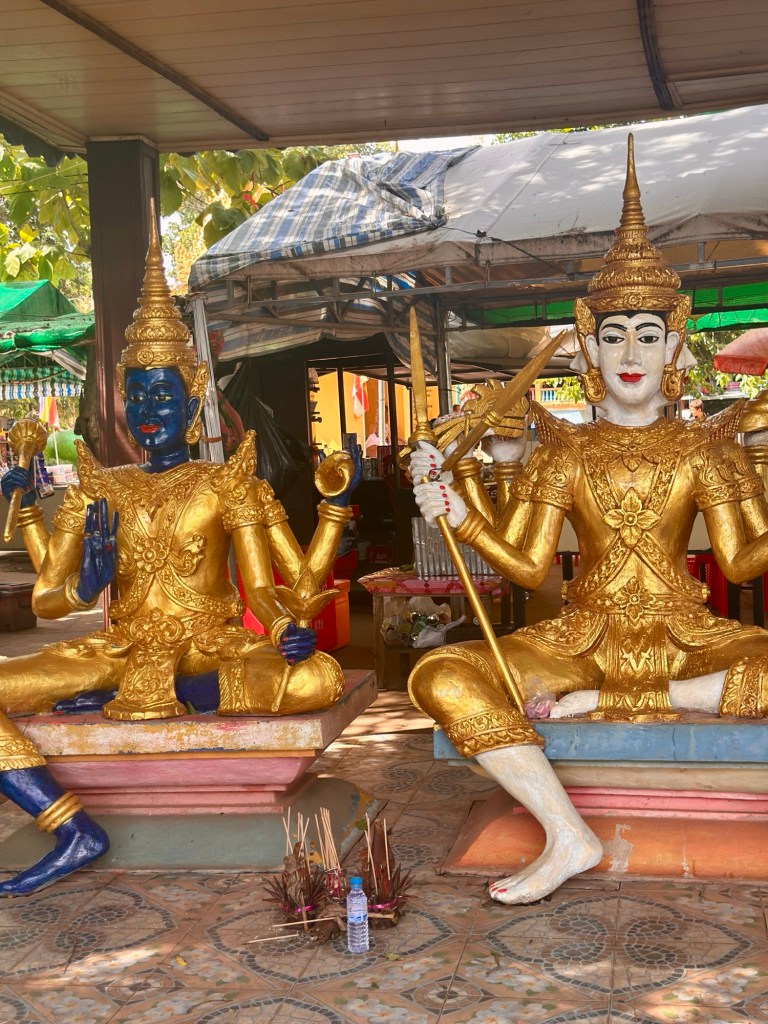
Wat Hanchey Temple
One of the things that makes Avalon’s Mekong cruise so special is how effortlessly you can access places along the river. There’s no formal port or long transfer—often the ship simply pulls up to the riverbank, and you step off directly into daily life.
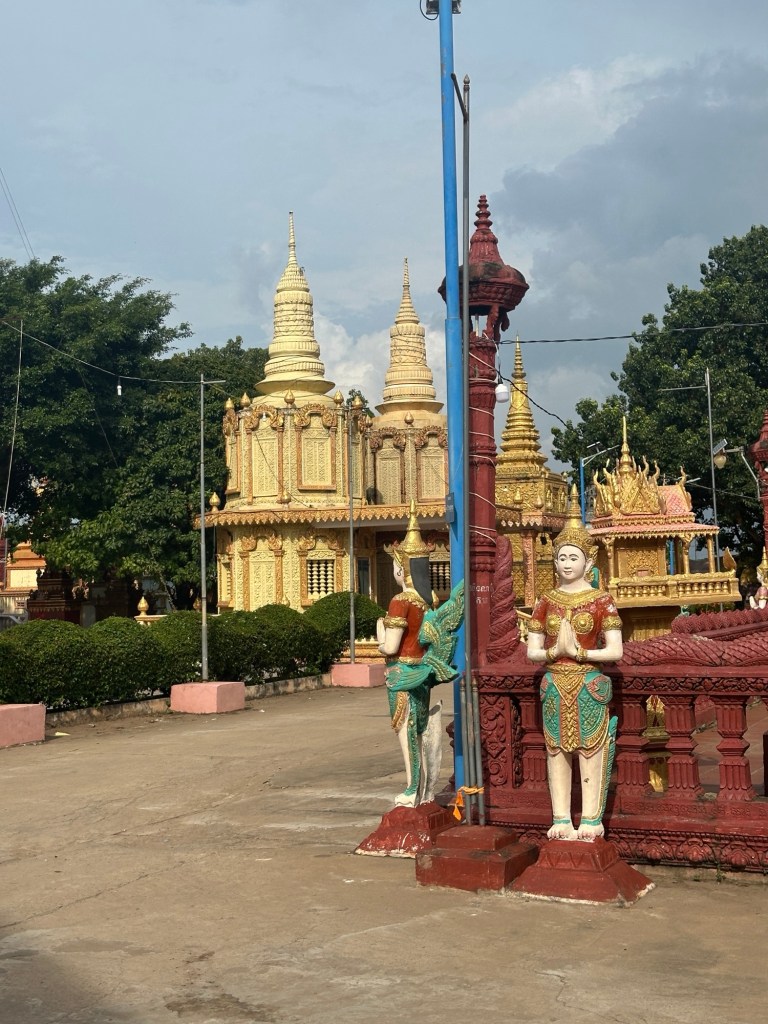
On this day, we stopped just outside Kampong Cham Province. After walking only a couple hundred yards from the ship, we found ourselves at the base of the steps leading up to Wat Hanchey—a mountaintop temple overlooking the Mekong River. (“Wat,” we learned, simply means temple.)
Climbing the 303 steps to the top was well worth the effort. From the summit, the views of the Mekong stretching below were expansive and peaceful, offering a completely different perspective from life on the water.
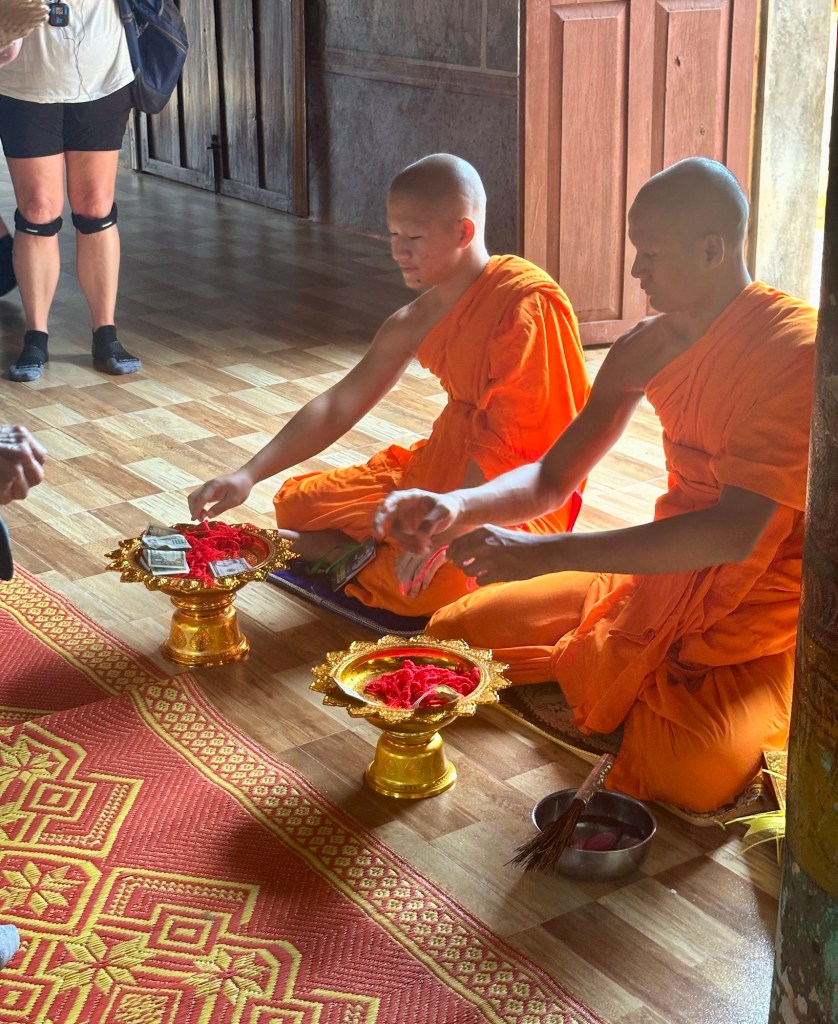
At the temple, we received a blessing from the monks—an experience that lasted about six minutes and felt both grounding and deeply meaningful. We also learned about the daily life of a monk. Novice monks can begin their training as young as nine years old, and becoming a monk is considered a great honor. Many Cambodian rulers and kings traditionally spent two to three years as monks before assuming leadership, a practice rooted in humility, discipline, and spiritual study.

Village of Angkor Ban
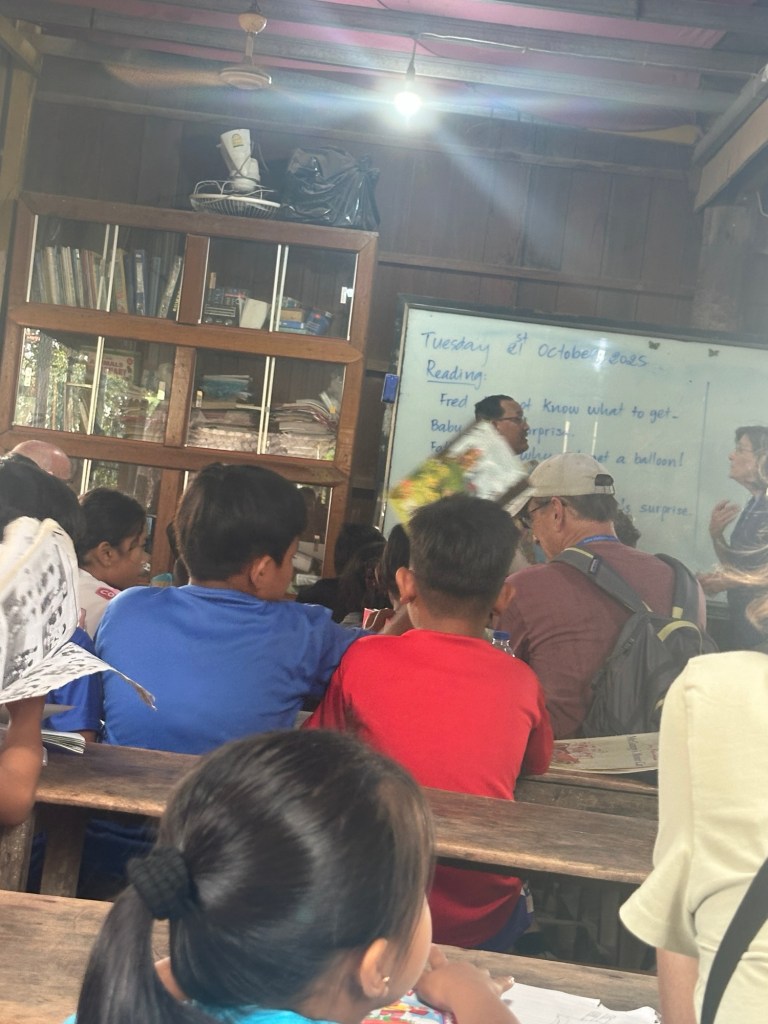
As we continued cruising down the river, the afternoon brought us to Angkor Ban village, where we walked from the riverbank to a local school tucked within the community.
Earlier that day, we had stopped at a local market to purchase school supplies for the students. Avalon sponsors this school and has made meaningful investments to enrich its programs, particularly in English education.
We arrived during their English-learning class, and the visit was immediately filled with smiles and nervous excitement. Each of us was paired with two children, all under the age of nine, who proudly practiced reading English aloud from their primary school books. The children also read together as a group, confidently demonstrating how much they’ve learned.
Before leaving, we had the chance to present them with notebooks and colored pens—simple gifts that were received with great enthusiasm. Many of the children were especially delighted by the idea of having their photos taken with us, turning the visit into a shared moment of laughter, connection, and joy.
It was one of those experiences that reminded us how powerful—and how simple—meaningful cultural exchange can be.
Day 7: Cambodia
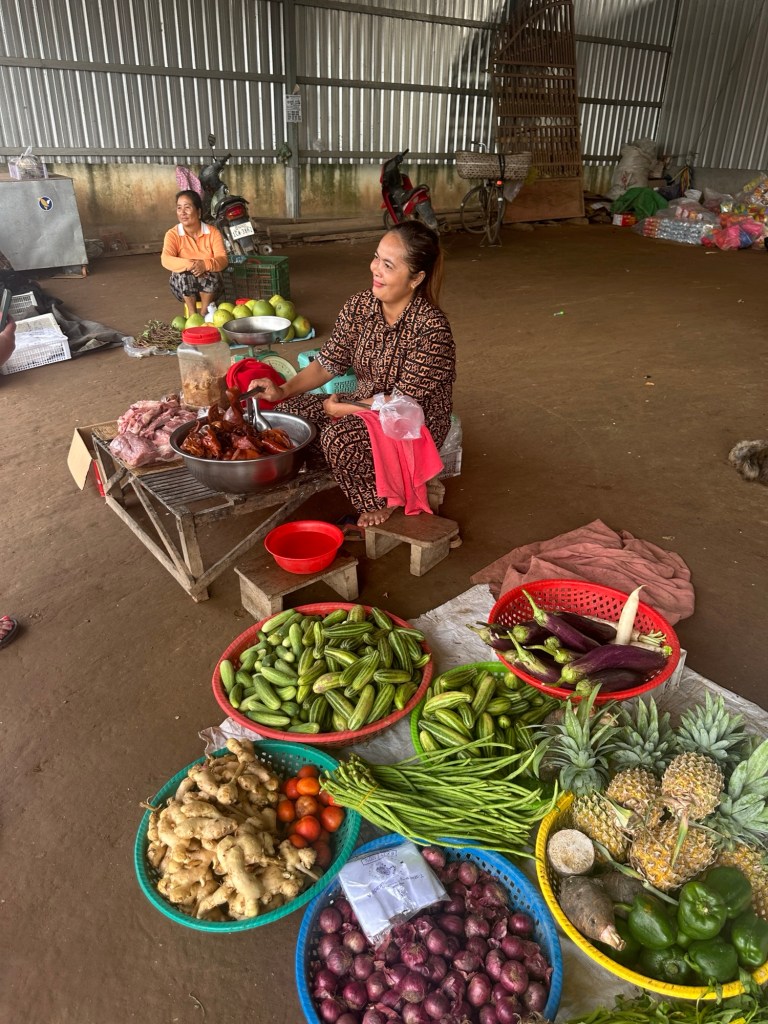
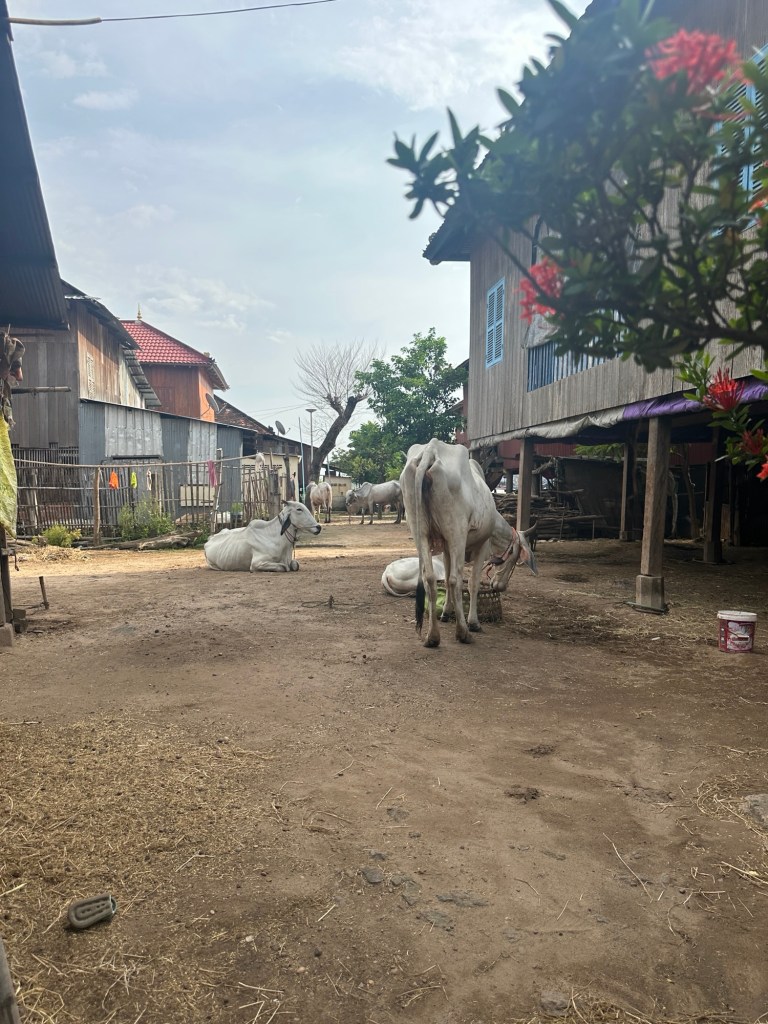
The Village of Kongpong Louann
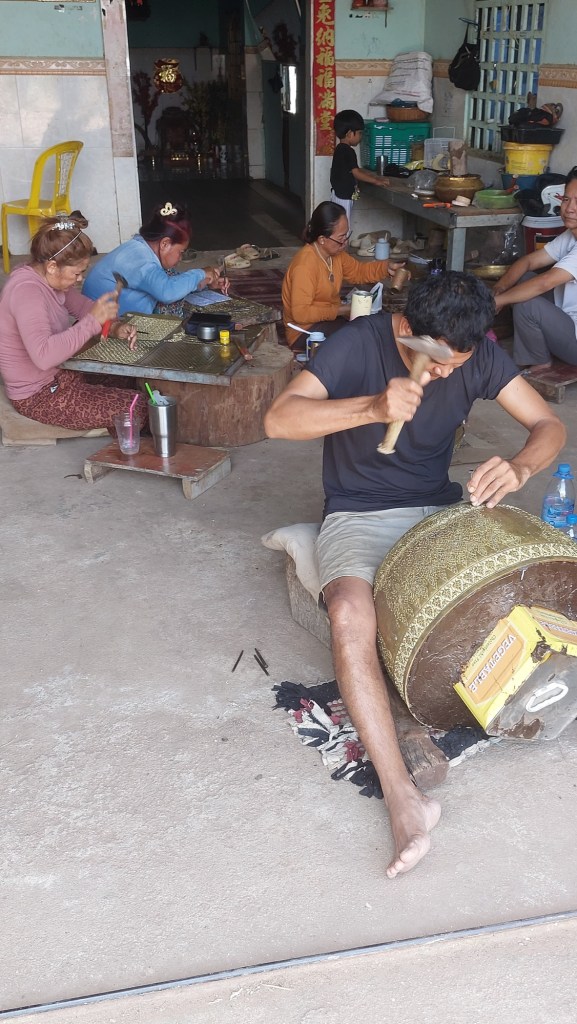
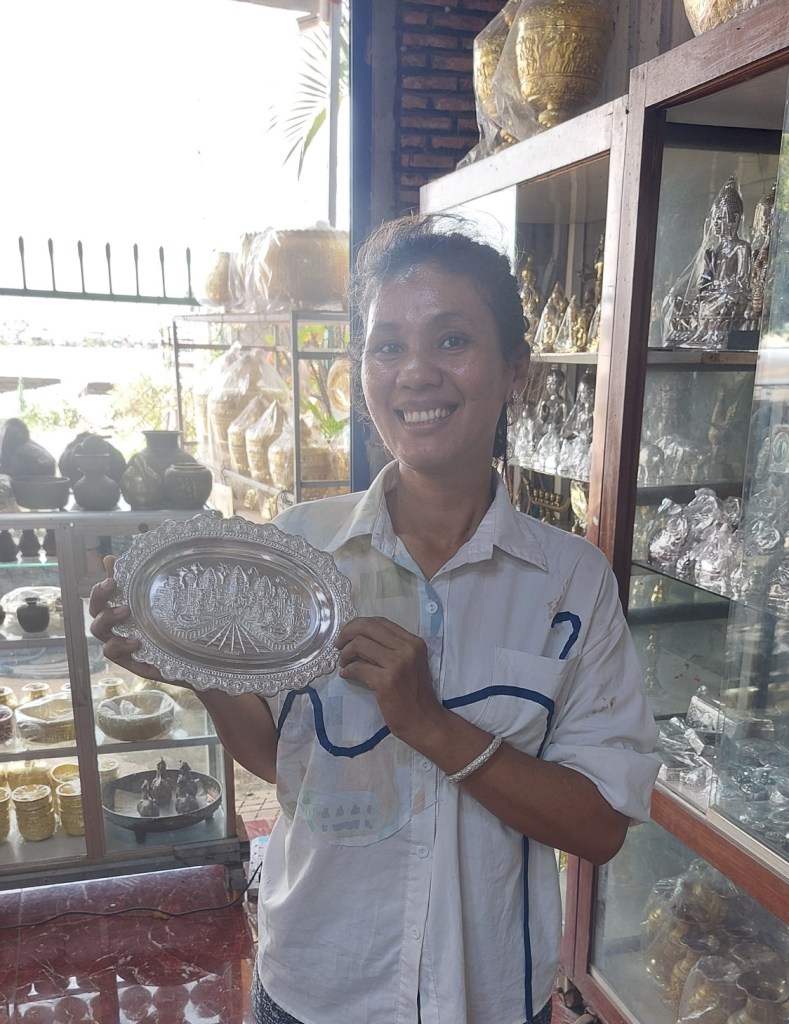
The following day offered a slower, quieter look at life in rural Cambodia. We were met by local farmers and began our visit with a stop at a silversmith village, where yet another traditional craft has been passed down through generations.
Inside small workshops, skilled artisans meticulously hammered scenes into silver plates entirely by hand. Each piece reflected hours of careful labor—landscapes, village life, and cultural symbols slowly emerging. Watching the process was a powerful reminder of the patience and pride behind Cambodia’s handcraft traditions.
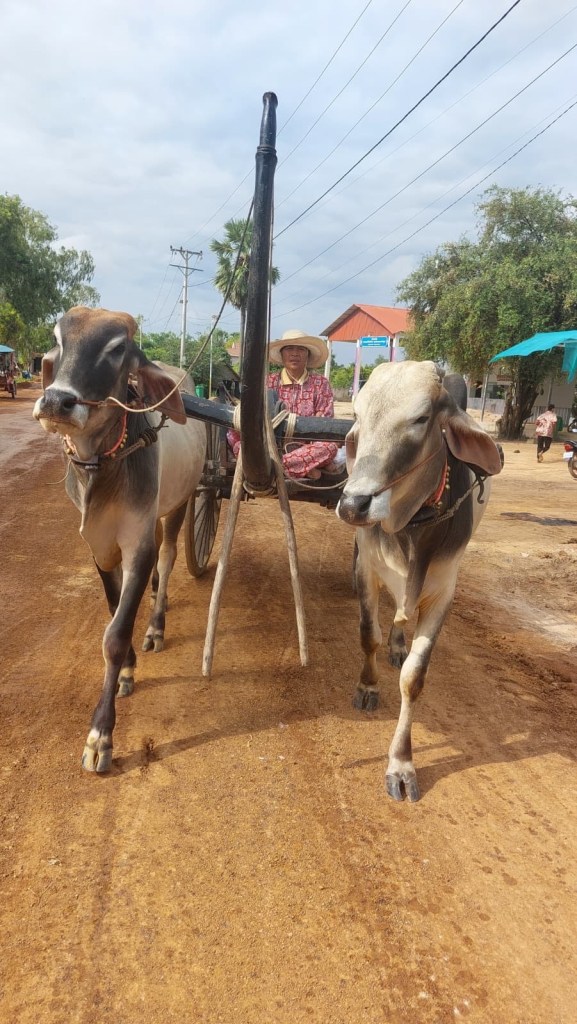
From there, we climbed aboard ox carts for a gentle ride through the countryside near Kampong Tralach. The pace was unhurried, allowing us to fully take in the surrounding rice fields, palm trees, and everyday rural life. Along the way, we stopped to meet a local farmer who shared insight into his daily routines and connection to the land.

Day 8: Disembarkation Day, and the End of the First Leg of our Journey
After ten unforgettable days aboard the Avalon Saigon, this chapter of our journey came to an end. Avalon also offers a post-cruise extension for travelers who wish to continue exploring the temples and beauty of Siem Reap, including Angkor Wat. You can read about our post-cruise magnificent temple visits here .
There were so many things we loved about this Avalon Mekong River Cruise. The ship’s small size creates an intimate experience—fewer guests, deeper connections, and a genuine sense of community. By the end of the cruise, we felt less like fellow passengers and more like fast friends.
We also loved the ease of exploring a new place each day while only unpacking once. It truly is the best of both worlds—combining the enrichment of a guided tour with the comfort and familiarity of staying in the same boutique hotel throughout the journey.
Perhaps most importantly, we appreciated the sense of safety, care, and local expertise Avalon provided as we explored a part of the world that was entirely new to us. From knowledgeable guides to thoughtful logistics, every detail allowed us to be fully present and open to the experience.
This journey along the Mekong was more than a cruise—it was a deeper understanding of history, culture, and daily life in Vietnam and Cambodia, and one we will carry with us long after returning home.
Written by Marci Fouts, founder of Sunning By The Sea Travel and lover of all things Southeast Asia. Marci believes travel is best when it’s shared — where laughter, friendship, and new experiences turn a trip into a lifelong memory.
 Explore with Me
Leave a comment